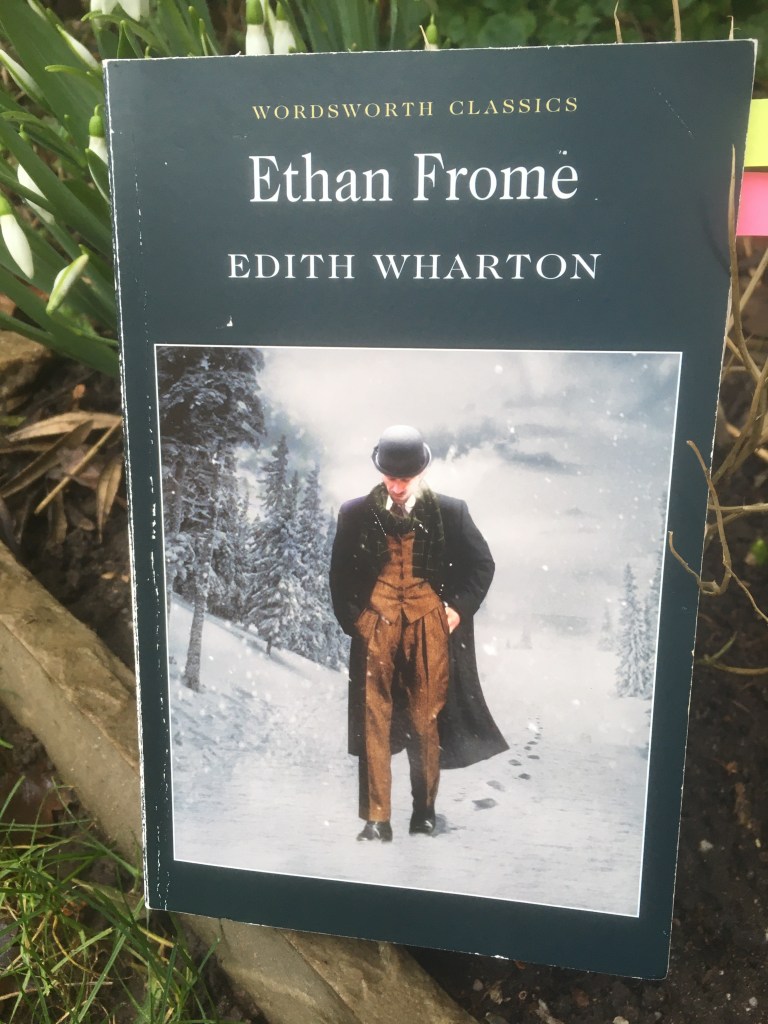
The Valley of Decision, Edith Wharton’s first published novel in 1902 was set in Eighteenth Century Italy. At the start of their lifelong friendship, Henry James offered Wharton some constructive criticism after reading this novel, namely she would be better advised to write about what she knew. Wharton took on board his advice as her next novel, The House of Mirth (1905) presented the trials and tribulations of Lily Bart as she attempts to navigate her way through the upper echelons of New York high society, a world which Wharton knew well. However, in her 1911 novella Ethan Frome, Wharton takes a different direction again. Gone are the lavish parties with women in elegant gowns posing in decorous drawing rooms. In Ethan Frome, the high life of New York is swapped for a lonely snowbound village in western Massachusetts and the harsh living conditions experienced by so-called ordinary folk in the previous century. I say ‘so-called’ because her novella received a certain amount of criticism for its depiction of working class characters. Nevertheless, Ethan Frome was greatly admired by Henry James. Wharton had also set her earlier novel The Fruit of the Tree (1907) in western Massachusetts and would return to the region again in her later novella Summer (1917).
In an introduction written for the 1922 edition of Ethan Frome Wharton explained she wanted to present something of the ‘harsh and beautiful land’ she had experienced whilst living in the area. She was implicitly critical of other regional writers such as Sarah Orne Jewett as she felt they idealised the locale, whereas she wanted to create a harsher feeling of ‘the outcropping granite’ of the country. There is indeed nothing soft and fern-like in her tale of poor Ethan.
Wharton uses a narrator to frame the story of Ethan whom he meets when he visits the town of Starkfield (note the appropriate name). As the snow moves in, the unnamed narrator becomes trapped in the isolated small town and this is when Ethan’s story begins to unfold. The narrator commences by telling the reader:
I had the story, bit by bit, from various people, and as generally happens in such cases, each time it was a different story. (Prologue)
The narrator takes shelter in Ethan’s home. On first meeting Ethan he is struck by his appearance as he was ‘the most striking figure in Starkfield, though he was but the ruin of a man.’ (Prologue). He looks like an old man and walks with a limp although he was only fifty-two. This was due to an accident some twenty-four years previous.
The introductory section functions as a frame narrative, a device often used in gothic stories. Whilst this is not an overtly gothic tale, it certainly borrows some elements from this genre. An air of mystery is created surrounding the history of Mr Frome by circling around the story a number of times and using repeated phrases such as ‘most of the smart ones get away.’ Just what has made him a ‘ruin of a man’? Starkfield is a fictional town, and indeed the carefully chosen name adds to the gothic feel of the location.
The reader is moved from the Prologue into the main body of the text and this is where the story begins to unfold. The basic story is relatively straightforward. A young Ethan Frome inherits the family farm from his father, a farm which was already failing and which takes all of his efforts to sustain. When his mother becomes ill his cousin Zenobia is sent to help care for her. On his mother’s death, Ethan’s prospects are bleak and he marries Zenobia (known as Zeena) to stave off the loneliness of winter. He reflects had it been summer he may not have been so inclined to marry. From the outset it is not a happy union as Zeena begins to experience one illness after another and becomes completely fixated on what she perceives as her failing health. Thus, Ethan has replaced a querulous complaining mother for a wife with similar qualities. Eventually, Zeena’s orphaned cousin Mattie Silver comes to live with them to help out with domestic duties. She is young, pretty and cheerful and poor Ethan falls in love with her.
On the surface this is a simple tale, however, it is packed full with psychological intensity. Wharton biographer Hermione Lee suggests the novella ‘comes as a great shock’ after some of her other novels, not just because of her change of class focus but because of its silence and control.[i] Although Wharton may more often be associated with her high society novels, she was actually a very diverse and prolific writer. Her outpourings also included ghost stories, travel literature, war writings, as well as a work on interior design.
Every reference to Zeena works towards establishing her awful appearance, which soon becomes clear to the reader, is a reflection of her personality. For example:
She sat opposite the window, and the pale light reflected from the banks of snow made her face look more than usually drawn and bloodless, sharpened the three parallel creases between ear and cheek, and drew querulous lines from her thin nose to the corners of her mouth. Though she was but seven years her husband’s senior, and he was only twenty eight, she was already an old woman. (Chapter Three)
Zeena constantly complains of various aches and pains and frequently seeks cures from a variety of medications. It was her so-called failing health which saw a double advantage in giving Mattie a home. Although Zeena felt obligated to take in her homeless orphaned cousin, she would also provide a source of free labour, allowing Zeena to move further into her chosen role of invalid.
The arrival of Mattie at the gloomy farmstead is like a breath of fresh air for Ethan. Whereas the light reflected by the snow emphasized Zeena’s faults, the light from the lamp enhances Mattie’s features:
… it drew out with some distinctness her slim young throat and the brown wrist no bigger than a child’s. Then striking upward, it threw a lustrous fleck on her lips, edged her eyes with velvet shade, and laid a milky whiteness above the black curve of her brows. (Chapter Four)
The tensions in the home soon begin to rise as the warmth of the attraction between Ethan and Mattie begins to grow. Zeena becomes ever more critical of Mattie and it is clear the situation will come to a head at some point. The drama of emotions is tightly controlled and Wharton admitted she was inspired by both The Blithedale Romance by Nathanial Hawthorne and Emily Bronte’s Wuthering Heights with regards to the text’s emotional intensity.
Much of the writing of Ethan Frome took place during the summer of 1910, a particularly challenging time in Wharton’s life. Although she was enjoying success in her career, her personal life had become difficult. Her husband Teddy had for sometime been suffering bouts of ill health and erratic behaviour. He had previously lost a large sum of Edith’s money due to his uncontrolled actions and by the summer of 1910 he was residing in a clinic. The doctors in Indiana diagnosed him as having ‘a psychosis’. To complicate matters, Edith was also embroiled in an affair with journalist and author William Morton Fullerton, an affair which was not destined to last. Later the Wharton marriage would completely breakdown and following her divorce Edith settled permanently in France.
Interestingly, the French translation of the Ethan Frome bore the title Sous la Neige (Under the Snow) which is actually rather appropriate, not just in terms of the weather, but in the emotions of the characters which seem destined to remain buried. So, as the weather turns colder and the days grow shorter, why not immerse yourself in some of Wharton’s atmospheric writing.
[i] Hermione Lee, Edith Wharton, London: Vintage Books, 2008, p.375


 Literary Likes