Halloween is the perfect time for reading ghostly tales. This offering from Edith Nesbit is set at that spooky time of year. Here is an excerpt of my article on her short story ‘Man-Size in Marble’. The full article can be found by following the link to the Wordsworth blog.
Halloween season, in common with Christmas, is the time of year many an avid reader will reach for a ghostly tale. Whilst sitting comfortably by the fireside hopefully the story will provide just the right amount of gentle chill to the room and a soft breeze to the back of the neck. If this description appeals, ‘Man-Size in Marble’ maybe just the tale you are looking for.
This story fits the bill in a number of ways, it is set in the period leading up to Halloween, with the climax occurring on that fateful night. The tale is told by a male narrator who immediately alerts the reader that this will not be a happy tale. The opening line sets up an air of mystery: ‘Although every word of this tale is true, I do not expect people to believe it.’ He goes on to reveal: ‘There were three who took part in this; Laura and I and another man. The other man lives still, and can speak to the truth of the least credible part of my story.’ There are indeed some troubling implications established in the first paragraph, however, before exploring the story further, a little background is in order.
‘Man-Size in Marble’ was first published in HomeChimes magazine in December 1887 and came from the pen of Edith Nesbit. If that name seems familiar, it is not surprising, as she would later become famous for her highly popular novel The Railway Children (1905) and other children’s fiction including Five Children and It (1902) and The Enchanted Castle (1907). However, in addition to her successful children’s fiction, Nesbit wrote a number of chilling ghost stories for adults, in addition to poetry and other works in collaboration.
To say Edith Nesbit led a Bohemian life would be somewhat of an understatement. When she married her husband Hubert Bland, she was already seven months pregnant. During their marriage, Bland fathered two children by Nesbit’s friend Alice Hoatson, and Nesbit raised them as her own. Both Nesbit and Bland had affairs and their home in Eltham was lively place with frequent visitors, including such well known names as H.G. Wells.
Nesbit and her husband were politically active and were the co-founders of the Fabian Society, to which the roots of the Labour party can be attributed. Nesbit and Bland also wrote fiction together under the pseudonym Fabian Bland. If you look carefully, some of her socialist beliefs are apparent in her children’s fiction. Although a politically active woman writer, her attitudes towards the Women’s Suffrage Movement was at best ambivalent and at times directly opposed. Some of Nesbit’s attitudes and beliefs appear to have worked their way into her gothic stories too, along with her lifelong fascination for ghosts.
To read my discussion of ‘Man-Size in Marble’ please follow the link click here
Recently, I was fortunate to have a very small involvement with some bibliography research regarding the newly published Wordsworth collection of Edith Nesbit’s ghost stories. I also wrote a blog discussing some of her ghostly tales which you can read an excerpt of below. If you would like to read the full article, just follow the link in the usual way.
Chances are, many readers know Edith Nesbit from her creation of courageous Bobbie in the successfully adapted 1905 novel The Railway Children. Or, possibly your first introduction was through the mysterious creature the Psammead in Five Children and It (1902), or perhaps the adventures of Jerry, Jimmy and Kathleen in The Enchanted Castle (1907). Therefore, some may be surprised to find images such as the following, flowing from the same pen:
… So he went upstairs, and at the door of the first bedroom he came to he struck a wax match, as he had done in the sitting rooms. Even as he did so, he felt that he was not alone. And he was prepared to see something but for what he saw he was not prepared. For what he saw lay on the bed, in a white loose gown – and it was his sweetheart, and its throat was cut from ear to ear.
This excerpt comes from Nesbit’s short story ‘The Mystery of the Semi-Detached’ included in her 1893 collection Grim Tales. In just a few lines she moves from creating a vague sense of unease to a startling shock. To say this is characteristic of Nesbit’s gothic writing is an oversimplification as she wrote many and varied short stories which could be categorized under the umbrella of horror. Whilst there are distinct similarities regarding some aspects of style and thematics across her tales, there is also a rich variety and this sense of variety is exemplified by the newly published Wordsworth Edition Man-size in Marble and Other Grim Tales.
Nesbit is not alone in being better known for other forms of writing, despite producing a significant amount of material in the horror genre. Writers such as Charles Dickens, Elizabeth Gaskell, Edith Wharton, Henry James and E.F. Benson all had notable forays into the realms of gothic despite being more usually associated with other forms of writing. Yet Nesbit wrote a large number of horror stories during the course of her writing career, although it is sometimes wrongly assumed this was simply something she did until her children’s stories made her famous. Her horror works span from the late Victorian era of the 1880s up until the post First World War period, with her final story ‘The Detective’ appearing in 1920.
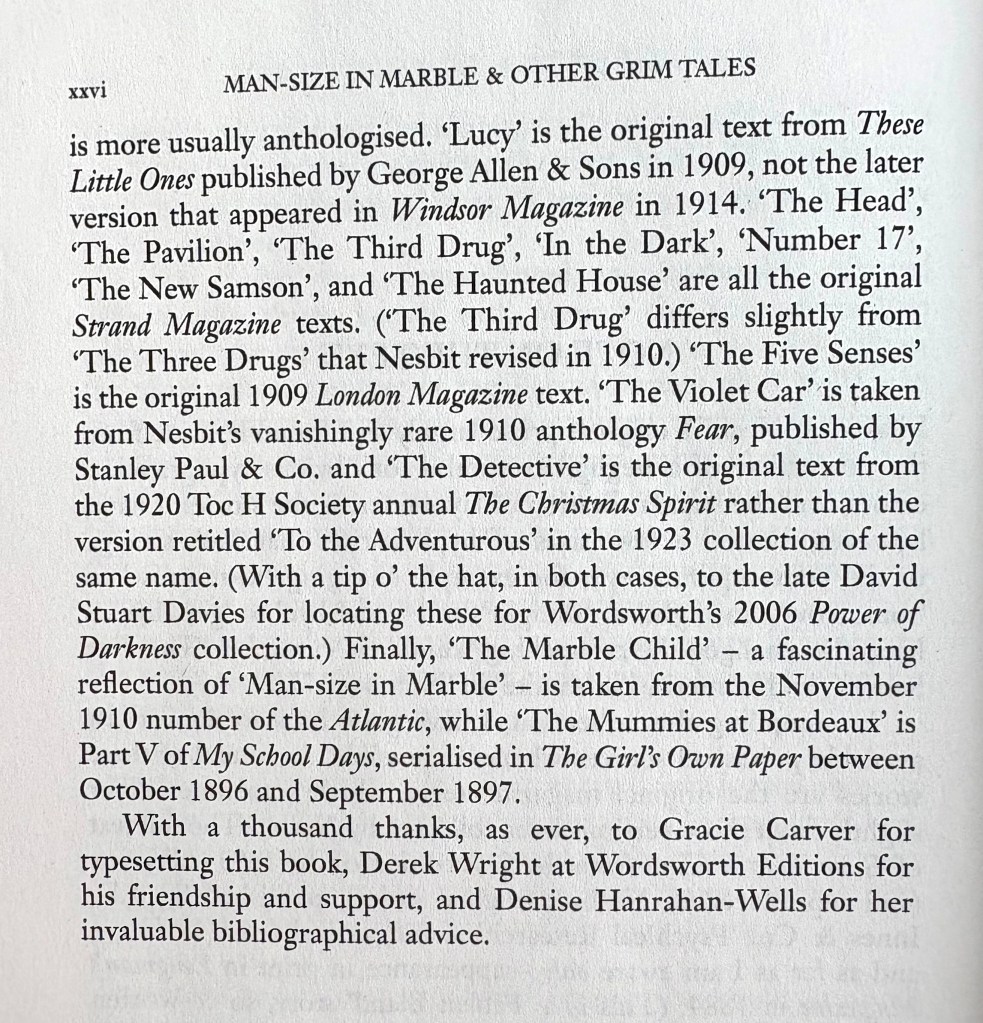
Many of her stories made their first appearance in popular journals of the day such as Longman’s Magazine, Temple Bar, Windsor, and London Magazine. The Strand Magazine, famous for its longstanding publication of Sir Arthur Conan Doyle’s Sherlock Holmes stories, also published many of Nesbit’s tales. She collected some of her short stories together in several volumes, beginning with the previously mentioned Grim Tales and Something Wrong in 1893. The Wordsworth Edition of her tales is unusual as it not only reproduces the Grim Tales collection in its entirety, but also includes all of her other horror stories, many of which have previously been overlooked.
Stephen Carver’s Introduction to the collection discusses how biographies and other secondary writings about Nesbit’s work tend to focus on her children’s fiction, whilst her horror stories tend to be dismissed. The Radio 4 programme Great Lives devoted an episode to Edith Nesbit on 22 April 2024. She was chosen by children’s writer Katherine Rundell who praised her for continuing to inspire children’s fiction today. Biographer Elisabeth Galvin joined the discussion and posited that Edith began writing through necessity as a young mother in order to help support the family. At that time her husband Hubert Bland was very ill, almost dying from smallpox. To compound matters his business collapsed when his partner absconded to Spain with all of their money. Thus, she would sit up late into the night writing what Galvin described as ‘her hack stories for newspapers.’ Galvin is not alone in viewing Nesbit’s gothic work in this way and it is difficult to ignore the negative connotations imbedded in such a term. The word ‘hack’ originates from Hackney Carriage, a form of transport available for hire. Thus a ‘writer for hire’, namely someone who produces large amounts of writing quickly to earn money, may well be viewed in negative terms. Similarly, genre fiction, for example horror and science fiction may also be dismissed as being popular, not highbrow or literary and thus unlikely to be art or to put forward important ideas. Clearly, this is a rather traditional, and some may say outdated stance, but may well explain why Nesbit’s horror stories have attracted little critical attention. A few of her stories have been anthologised over the years, most commonly ‘Man-size in Marble’ as well as ‘John Charrington’s Wedding’ and ‘The Ebony Frame’.
Elisabeth Galvin’s biography of Nesbit does make mention of her horror stories, and unusually finds value in them, a position with which I agree. Galvin suggests they originate from the mind of someone who was unhappy, and if you follow the details of her life, this may well seem true. However, she states Nesbit should be ‘applauded for her pioneering ghost stories that were several degrees chillier than anything that had been written before.’ Nesbit does indeed develop a considerable amount of chill in her stories. Whilst there are some similarities and recurring images, there are distinct differences too. Sometimes there is a logical explanation for what initially appeared to be supernatural, other times the horror is unapologetically supernatural in origin. Unusually for a lady writer of the time, many of her narrators are male, and not all of them are heroic. The Wordsworth collection nicely exemplifies the range of her horror writing. A few of the stories are quite humorous and playful, offering a little light relief from the darkly gothic tales, not all of which have happy endings. Other stories defy expectations such as ‘The Haunted House’ first published in The Strand Magazine in 1913. As its name suggests, this starts out as a haunted house tale, whereby the male protagonist answers an advertisement to investigate strange phenomena and arrives ‘in front of a white house with bare, gaunt windows.’ However, this is a story which shifts the ground beneath the reader as the narrative progresses. How? Well, you will need to read it to find out.
To read the rest of this article, please follow the link to Wordsworth Editions Click here


 Literary Likes
Leave a comment