Tag: literature

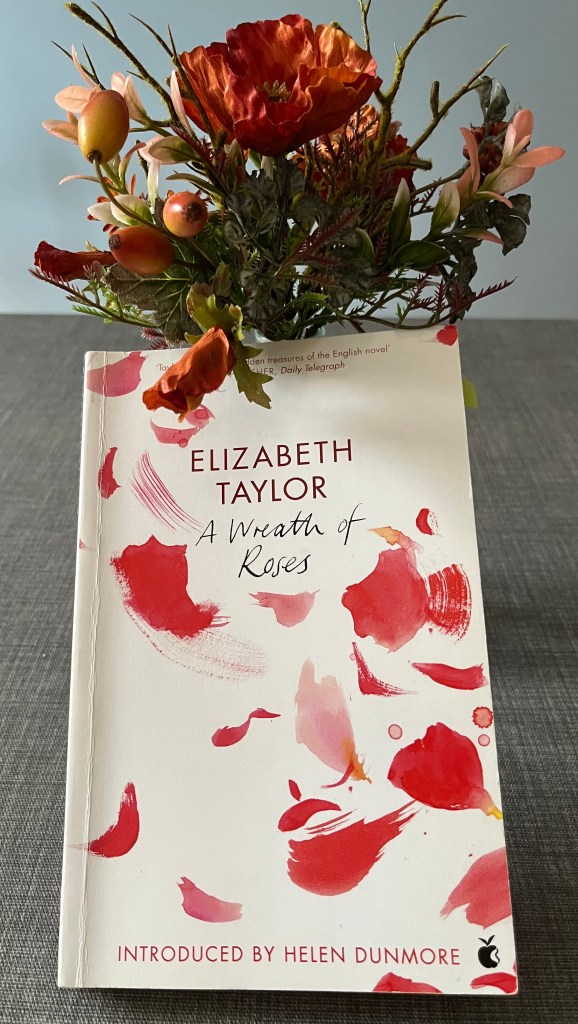
  • A Wreath of Roses by Elizabeth Taylor

    I have only read one other Elizabeth Taylor novel, A View of the Harbour (1947) and enjoyed the depth of characterisation and attention to detail of the facets of everyday life.  I was not disappointed with A Wreath of Roses, a novel which led to some interesting discussions when I taught it to my Literary Class a couple of years ago.

    Taylor has been compared to Jane Austen for her gentle comedy, her observations about class and how money works in society.  Carmen Calil, founder of Virago Press describes her as funnier and cleverer than Jane Austen. She praises her for the way in which she deals with anxiety, and her perception of human nature.  However, whilst Jane Austen is useful for the basis of a comparison, her writing seems to have a darker side.

    The overall premise of the plot of A Wreath of Roses is simple enough.  Friends Camilla and Liz reunite every year and spend the summer with their former governess Frances.  However, this year seems different for Camilla as Liz now has a baby and Frances seems evermore absorbed by her painting.  The introduction by Helen Dunmore in my edition describes it as Taylor’s darkest novel, and indeed the opening chapter takes a dark turn.  It begins on an ordinary summer afternoon on a station platform as Camilla is waiting for the train.  However, the bright and warmth of the season becomes undercut by a sense of building tension which culminates in a man jumping from a footbridge as the train pulls into the station.  In the aftermath, Camilla seeks comfort by talking to a stranger on the train, Richard Elton.  She is perturbed and intrigued by this encounter in equal measures, as he is clearly quite a mysterious character:

    And now that her curiosity was at last aroused, he withdrew his attention, turned again to his newspaper and appeared to be reading with complete absorption the account of a murder.  (Chapter 1)

    Admittedly, this is quite low key manipulative behaviour, but he succeeds in gaining her interest.  Richard is apparently returning to the town to gain some peace whilst writing a book about his dramatic experiences during the war.

    It emerges, as the novel progresses, that all three women are going through some form of discontent with their lives. Camilla is bored with her life, wondering if she is going to remain an unmarried school secretary for ever.  Liz is struggling to adapt to her married life with a new baby, whilst Frances is having difficulties of the artistic kind with her art.  Thus, Camilla falls prey to a potentially dangerous liaison with the mysterious Richard Elton, a man who may not be what he seems.  Even Camilla says his name is like a pseudonym a writer would use.

    The ghost of the Second World War sometimes hovers subtly in the background, other times it is more overtly evoked through descriptions of the ghastly food offered at the hotel when Camilla and Richard dine there together (see chapter 11).

    I rather like the fact that the novel begins with an epigraph from The Waves by Virginia Woolf:

    So terrible was life that I held up shade after shade.  Look at life through this, look at life through that; let there be rose leaves, let there be vine leaves – I covered the whole street, Oxford Street, Piccadilly Circus, with the blaze and ripple of my mind, with vine leaves and rose leaves.

    This rather unsettling epigraph provides a hint of the darkness to follow, as indeed, does the title.  Roses, whilst beautiful, have thorns, and it is not a bouquet of roses, but a wreath.

    The Backlisted Podcast describes Elizabeth Taylor as one of the most overlooked writers of the Twentieth Century, and one which I am encouraged to explore further.

  • Pride and Prejudice

    In honour of Jane Austen’s 250th birthday last week, here is my piece on Pride and Prejudice.

    When I first read Pride and Prejudice as a moody fourteen year old, I was far from impressed. I had little interest in the characters, even less enthusiasm for the society in which they lived, and as for the preoccupation with marriage, well that just left me cold.  Some of you dear readers may gasp in horror at such notions.  However, my fourteen year old self was in good company, as Charlotte Brontë also thought Miss Austen was somewhat over-rated. In a letter to her friend, the literary critic G. H. Lewes she asked: ‘Why do you like Miss Austen so very much? I am puzzled on that point.’ On the basis of Lewis’s praise she went ahead and read Pride and Prejudice and delivered her verdict:

    And what did I find? An accurate daguerreotyped portrait of a common-place face; a carefully-fenced, highly cultivated garden with neat borders and delicate flowers – but no glance of a bright vivid physiognomy – no open country – no fresh air – no blue hill – no bonny beck.  I should hardly like to live with her ladies and gentlemen in their elegant but confined houses. (Quoted in Elizabeth Gaskell, The Life of Charlotte Bronte, p.258)

    Ouch. In other words, Jane Austen’s style of writing is controlled, contained and ‘confined’, and one could even say, despite the sophistication of the society presented, it is a little common-place.  That is, if you agree with Miss Brontë.

    The next time I encountered Pride and Prejudice I was a mature undergraduate student and I was not all that enthused as finding this novel on my reading list.  However, after reading the first chapter I experienced a shift in my earlier opinions and was impressed by how much Austen achieves in the space of just a few pages.  Plus I immediately began to appreciate Austen’s humour.

    The opening sentence is one of the most well known beginnings to a novel in English literary history: ‘It is a truth universally acknowledged, that a single man in possession of a good fortune, must be in want of a wife.’  The narrative voice continues to explain that regardless of how much or little is known about said man, such ideas are so powerful ‘he is considered as the rightful property of some one or other of their daughters.’  We are then introduced to Mr and Mrs Bennet and from their ensuing dialogue on the subject of the newly arrived Mr Bingley into the neighbourhood their characters are firmly established.  Mr Bennet appears quick witted and seems to enjoy using his words to toy with his wife. His response to her laying claim on Mr Bingley as a potential husband for one of their daughters is the question ‘Is that his design in settling here?’ Her lack of insight is immediately apparent as she takes his question at face value whilst the reader recognizes his sarcasm.  As their exchange continues Mrs Bennet declares ‘… You take delight in vexing me. You have no compassion for my nerves.’ Her husband’s witty retort once again is not absorbed by her and is again at her expense:

    ‘You mistake me, my dear. I have a high respect for your nerves. They are my old friends. I have heard you mention them with consideration these twenty years at least.’

    Thus, the first chapter establishes the social world of the novel, with its rules and traditions, it introduces some of the significant characters in a mildly humorous way, and in case the reader is in any doubt about Mrs Bennet, concludes by informing us ‘The business of her life was to get her daughters married; its solace was visiting and news.’

    To read the rest of this article please follow the link to the Wordsworth blog by clicking here