This is a recently written article.
Robert Louis Stevenson was only 44 years old when he died, yet during his short life he produced many works and lived in many places. He was born in Edinburgh in 1850 and died on the Pacific island of Samoa in 1894. In between, he lived in London, the French Riviera, Fontainebleu, Belgium, California (including Monteray and San Francisco), Bournemouth, the Adirondacks in New York State, and Hawaii. As may be apparent, he travelled extensively and often earned an income from his travel writing. Amidst this list of interesting and far flung places you may have noticed mention of Bournemouth, and it is this period of his life which most interests me, not least because it was a highly productive period during which he wrote many of his best known works. But how did he end up in Bournemouth?
I do not propose to give a full biography of his life, just a brief summary. I do, however, recommend Robert Louis Stevenson: A Biography by Claire Harman for a comprehensive exploration of his life and works.
Stevenson was an only child, raised by his comfortably middle class parents and a strict Calvanist nurse. They were extremely protective of him because he was a sickly child who spent long periods of time in bed. Ill health would dog him throughout his entire life and is the reason he ended up spending three years in Bournemouth. It is not known exactly what was wrong with him but it is clear he suffered bouts of respiratory illness, including haemorrhages, often resulting in him being bedridden. Throughout his entire life he was extremely thin, and photos of him show he struck a gaunt and rather charismatic figure. Again, see Claire Harman’s biography for more detail on his health conditions. Thus, it is ever more impressive that he was such a prolific writer during his short but productive life. Some of his work was produced quite rapidly. For example, Treasure Island began life as a treasure map drawn to amuse his stepson during a rainy period in Braemar, Scotland. This turned into a list of chapter headings and by the following day he had written three chapters.
Mention of his stepson leads me on to his initially unconventional married life. During his twenties, whilst in France, he fell in love with an American woman by the name of Fanny Osborne. She was ten years his senior, and was also married. She separated from her husband and they later divorced. Stevenson never had any children of his own, but remained close to his stepsons and even tried to promote the elder one as a writer. The couple were eventually married and during their travels sought health cures in Switzerland and the South of France.
Following one of their sojourns in the south of France, Stevenson wanted to return to be closer to his father Thomas, whose health was also declining. Rather than returning to the less temperate climate of Scotland, which had worsened his health on a number of previous occasions, they decided to set up home on the south coast of England. By the mid nineteenth century Bournemouth had become a popular convalescent destination, and thus the Stevensons set about finding their new home. They settled on a house named ‘Sea View’ and immediately put their stamp on the place by changing its name to ‘Skerryvore’ after the Skerryvore lighthouse built by the Stevenson family on the Argyle coast. The house was bought for them by his parents, probably as an attempt to keep the couple a little closer to Scotland. They took up residence in April 1885 and it was their first home which was not rented.
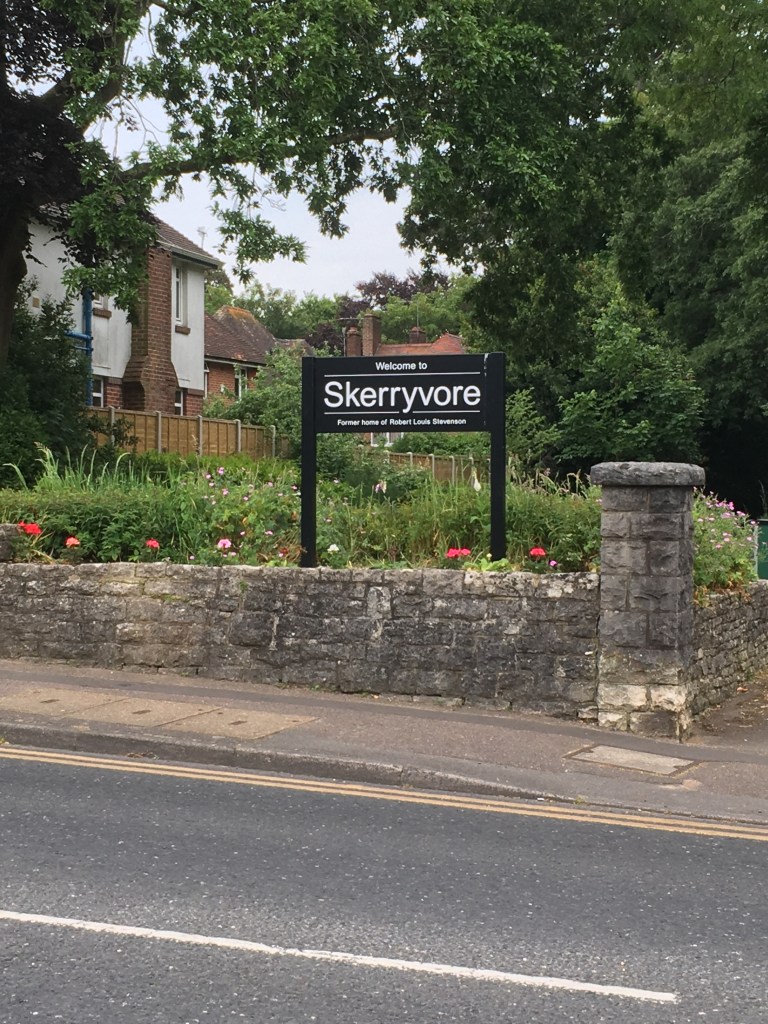
Harman describes the house as “a yellow-brick villa on Alum Chine Road, about a mile’s walk from the sea.” (p.275) It was actually located in Westbourne, a district of Bournemouth. Their short time there is rather curious. Stevenson saw no improvement in his health despite the claims of the healing properties of sea air. He described his life at Skerryvore as like “a weevil in a biscuit” and Claire Harman uses this phrase as the title of her chapter on Stevenson’s experiences in Bournemouth. Although he was forced to endure long bouts of bed rest, paradoxically, it was one of his most productive periods during which he wrote some of his best known works. These included:
- More New Arabian Nights: The Dynamiter (1885)
- Prince Otto (1885)
- A Child’s Garden of Verses (1885)
- Kidnapped (1886)
- The Strange Case of Dr Jekyll and Mr Hyde (1886)
1885 was clearly a productive year as he also wrote short stories ‘Markheim’, ‘Hester Noble’, ‘The King’s Rubies’, and ‘Ollala’. In addition, he wrote the essay ‘A Chapter on Dreams’ although this was not published until 1892. He was productive in the poetry line too including ‘The Mirror Speaks’ written about a mirror given to him by Henry James. He also worked on some unsuccessful plays with his friend William Ernest Henley, but it is probably best to draw a veil over these!
For me, the biggest surprises were to discover Kidnapped and Jekyll and Hyde emerged from his time in Bournemouth, as these are both so evocative of other places. Indeed, none of his work seems to bear any evidence of Bournemouth settings and inspiration.
It is now impossible to read The Strange Case of Dr Jekyll and Mr Hyde without some prior knowledge or assumptions about the plot, due to numerous adaptations which have emerged over the years. If you have not actually read the original I urge you to do so because it is a rich text which raises some interesting issues about late Victorian society, and will undoubtedly hold some surprises for the first time reader. The creation of the text is somewhat legendary and as with any good legends, there are variations in the story. One version describes him throwing the completed manuscript into the fire following criticism from his wife Fanny, after which he rewrote the tale. Nevertheless, all versions seem to concur that the story was written rapidly, over the course of three days or so, whilst he was confined to bed. Whilst the writing may have been a speedy process, he had long been thinking about the idea of man having a dual nature as evidenced from a later essay ‘A Chapter on Dreams’, where he says he:
… had long been trying to write a story on this subject, to find a body, a vehicle for that strong sense of a man’s double being which must at times come in upon and overwhelm the mind of every thinking creature.
The setting is distinctly London with no hint of sea air. Instead, we have atmospheric fog bound streets, and there are numerous descriptions along these lines:
The dismal quarter of Soho seen under these changing glimpses, with its muddy ways, and slatternly passengers, and its lamps, which had never been extinguished or had been kindled afresh to combat this mournful reinvasion of darkness, seemed, in the lawyer’s eyes, like a district of some city in a nightmare. (Chapter 4)
Claire Harman believes Stevenson possessed an impressive sensory memory. During his final years in Samoa, he was often writing of Scotland. This may well explain how he was able to write so convincingly of other places whilst being bed-bound in Bournemouth.
Despite bouts of ill health, Stevenson still managed to become part of a social scene. Writer Henry James became a frequent visitor to Skerryvore as he was staying in the area whilst his sister Alice had moved to Bournemouth for her health. Stevenson and James had previously enjoyed a lively correspondence, and now he found himself a regular dinner guest.
There is quite a well-known and rather unusual portrait of Robert (or Louis as he preferred to be known) and Fanny Stevenson, by John Singer Sargeant which was painted during their first year of living at Skerryvore. This depicts the couple in their dining room, but the composition is highly unusual. Rather than the traditional pose of couple seated together in the middle of the frame, Stevenson appears to be walking towards the left, whilst Fanny is seated at the extreme right, only partially in frame. A doorway, just off centre divides the couple and the overall effect is somewhat disconcerting.
Living nearby was Sir Percy Florence and Lady Jane Shelley, son and daughter-in-law of Romantic poet Percy Bysshe Shelley. Lady Jane likened Stevenson to Shelley, even though she had never met her father-in-law. This may well have been due to Stevenson’s somewhat romanticised persona of the suffering tortured genius doomed to die young. According to Harman, Stevenson was quite flattered by the attention and agreed to pose wearing a cape for Sir Percy who was a keen photographer. Thus, the Stevensons’ time at Skerryvore was far from being a period of isolation.
Their time in Bournemouth came to an end following the death of his father. They decided to set off on a tour of the South Seas, not realising they would never return to Skerryvore. They spent time in Hawaii before ultimately settling in Samoa, where Stevenson eventually died of a brain haemorrhage at just forty-four years of age.
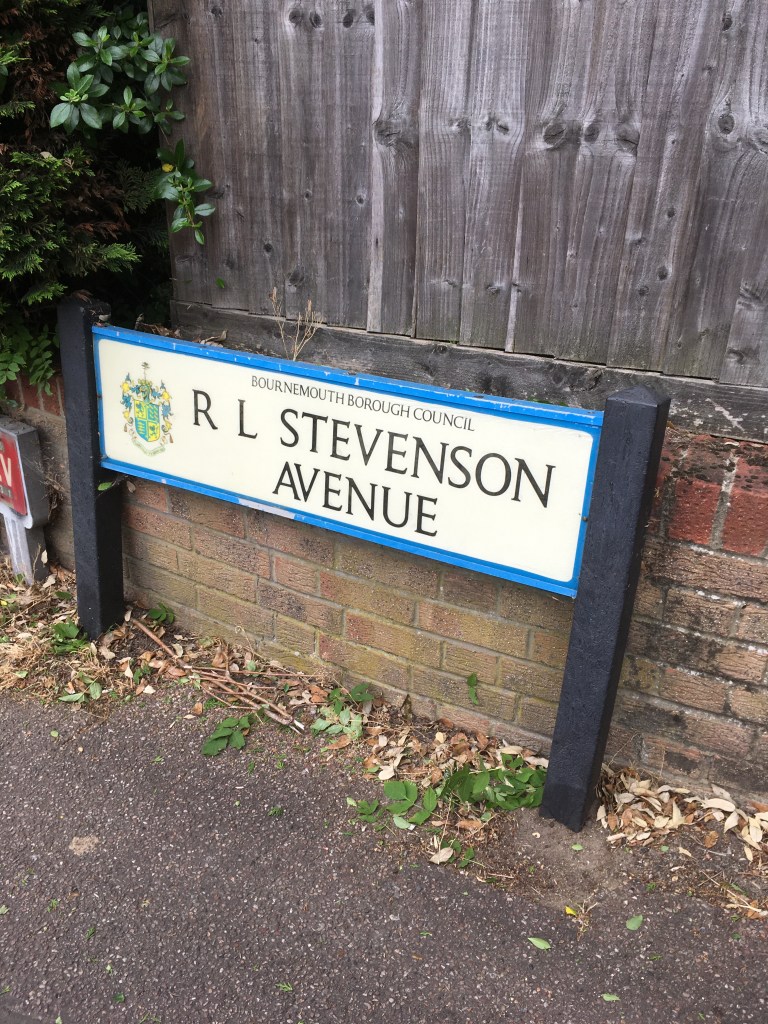
What of Skerryvore? Sadly, it was destroyed during the Second World War by enemy bombers on 16 November 1940. Thankfully the remains of the house have been preserved to the extent that it is possible to see the layout of the ground floor. Nearby in the grounds, there is a little monument inspired by the original Skerryvore lighthouse. The memorial stone reveals the garden was designed and constructed by the former Bournemouth Corporation in 1957 in memory of the writer. Nearby, can be found R L Stevenson Avenue. Although Stevenson may not have enjoyed the health cure he so eagerly sought, his time at Skerryvore will be remembered.

 Literary Likes
Leave a comment