Author: Literary Likes

  • Agatha Christie, Dead Man’s Folly and Greenway House

    Many of the country house settings found in classic crime fiction are now the kind of stately homes you might find on a visit to a National Trust property.  The connection between the two becomes ever stronger regarding the novel Dead Man’s Folly and Greenway House in Devon.  Both form part of the extensive heritage left by one of the most famous crime writers, Agatha Christie.

    Dead Man’s Folly, published in 1956, began life as a shorter text, ‘The Greenshore Folly’.  Agatha Christie wrote it in 1954 with the intention of donating the rights to Churston Fetters Church to raise money for new stained glass windows.  However, the story was difficult to sell as it was too long for a short story but not long enough for a novel.  Never one for waste, Christie turned part of the text into a short story, ‘Greenshaw’s Folly’, featuring Miss Marple, which she gave to the church.  She then produced a longer work which we now know as the Hercule Poirot novel Dead Man’s Folly.  The ‘Greenshaw’ of the earlier incarnation may have provided a clue regarding the setting as she drew inspiration from her beloved holiday home Greenway House in Devon.  Names were changed though.  The river Dart became the river Hel, and Greenway House became Nasse House.   Christie had drawn upon her Devon home in other novels – Five Little Pigs, Ordeal by Innocence and Towards Zero.  However, it is in Dead Man’s Folly that the house and grounds are most clearly evoked.

    Agatha Christie bought Greenway House in 1938 during what she described as her ‘plutocratic period.’  It was advertised in Country Life where it was described as “suitable for a first class hotel.”  Lucy Worsley, in her biography Agatha Christie: A Very Elusive Woman, highlights how remarkable such a purchase was, as at this point in time most large country houses were being sold off, and not being bought as private residences.  This is reflected in Dead Man’s Folly where the former lady of the manor Mrs Folliat, who now lives in the lodge by the front gate declares:

    Nice to have Nasse lived in again.  We were all so afraid it was going to be a hotel… One drives through the country and passes place after place with the board up “Guest House” or “Private Hotel”… All the houses one stayed in as a girl – or where one went to dances.  Very sad.  (Chapter 5, p.62)

    Christie’s initial enjoyment of Greenway was short lived as when the Second World War began the house was commandeered by the Admiralty and not returned to her until February 1945.  Her love for the house is clear from her own autobiographical writings, as well as the way it is evoked in her previously mentioned works of fiction.

    Dead Man’s Folly begins with Hercule Poirot receiving a call for help from his good friend the famous crime writer, Ariadne Oliver.  Mrs Oliver is staying at Nasse House in Devon, which is the home of Sir George and Lady Stubbs.  She has been tasked with devising a Murder Hunt for their garden fete, but her intuition leads her to tell her old friend “But I think there’s something wrong.” (Chapter 1, p.11) There is a form of doubling occurring in the text as the grounds of Nasse House is the setting for a murder mystery style treasure hunt, and subsequently becomes the scene of an actual murder.  Ariadne Oliver is indeed right, her plans are being manipulated.

    I am not sure if it is because I am familiar with Greenway following my visit, and thus have firm images in mind, or whether Christie’s love of the house is coming through, but this text feels particularly evocative regarding location and sense of place.  This begins with Hercule Poirot’s chauffeur driven arrival:

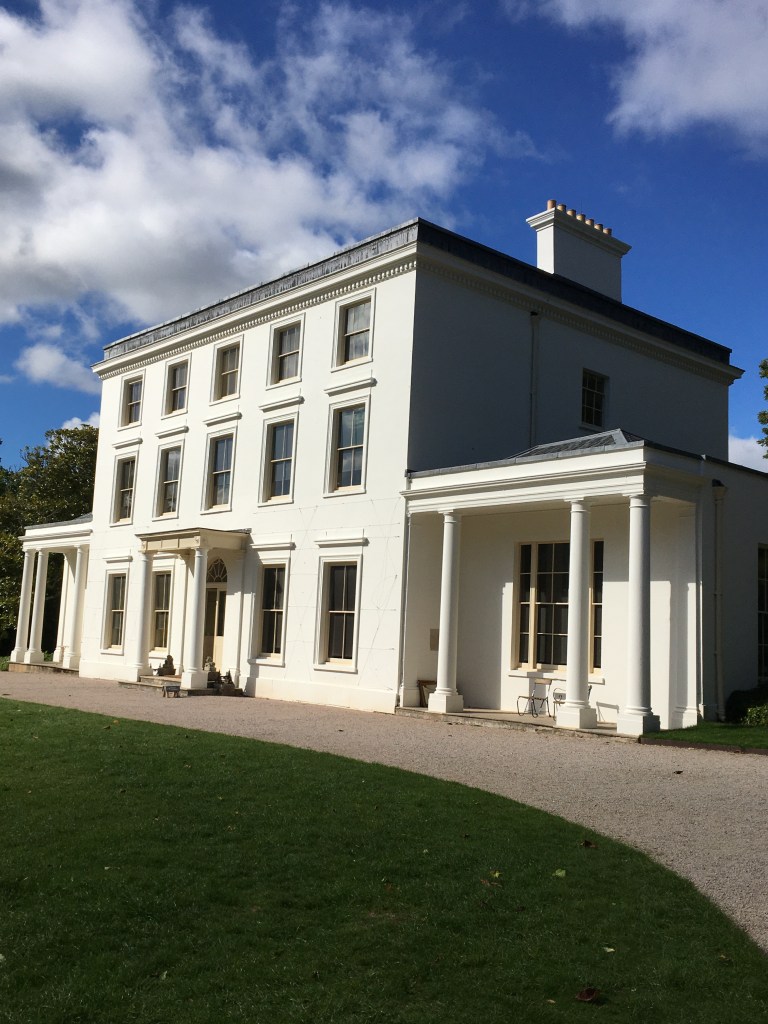
    They went on, down a steep hill through woods, then through big iron gates, and along a drive, winding up finally in front of a big white Georgian house looking out over the river.  (Chapter 1, p.8)

    The grounds with its many interesting features and self-contained areas provides the perfect setting for a treasure hunt style murder mystery, as seen by Poirot’s attempts at navigating his way through the clues:

    … Poirot went off murmuring to himself like an incantation: Tennis Court, Camelia Garden, The Folly, Upper Nursery Garden, Boathouse…

    The event of the Summer Fete helps in providing the usual cast of suspects required in any classic murder mystery as Sir George and Lady Stubbs have a number of guests staying with them.  In addition, the house next door has been converted into a Youth Hostel providing a few additional suspects in the guise of trespassers.  Added to the mix, as well as a murder, there is a disappearance and an unexpected arrival of a long lost relative.  Thus, there is plenty to keep the reader engaged, and some quality Christie plotting.

    At this point, it is worth returning to Ariadne Oliver, a character who appears in several Christie novels and who the author admits is partly based on herself.  Christie has been known to use this character in particular ways, sometimes to make comment on the process of writing.  Indeed, she is already tired of her detective character Sven and regrets making him Finnish as she has never been to Finland and knows nothing about the country.  There are echoes here of Christie’s creation of the Belgian Poirot!  When attempting to explain the plot of her treasure hunt the brilliant Poirot blinks “in mute incomprehension.” (Chapter 4, p.38).  She bemoans the need to explain her story as she prefers to write things down as verbally explaining her plots always ends in “the most frightful muddle.” (p.40) Poirot says nothing but privately reflects the “whole plot and action of the Murder Hunt seemed to be wrapped in impenetrable fog.” (p.41) Fortunately Christie’s plot, whilst requiring careful attention, is somewhat clearer.

    It is interesting though, that a novel set in her home, also contains some further personal reflections.  Ariadne Oliver is used to such effect during the treasure hunt where she encounters a competitor:

    ‘They say Mrs Ariadne Oliver is down here herself somewhere about. I’d like to get her autograph. You haven’t seen her about, have you?

    ‘No’, said Mrs Oliver firmly.

    ‘I’d like to meet her. Good yarns she writes.’ He lowered his voice. ‘But they say she drinks like a fish.’

    He hurried off and Mrs Olive said indignantly: ‘Really! That’s most unfair when I only like lemonade.’  (Chapter 6, p.77)

    This is based on an exchange Christie overheard between two women, whilst keeping her identity secret.  They praised her writing but commented they had heard she drinks like a fish.  Rather than being offended, she was mildly amused.  Agatha Christie was T-total, and her drink of choice was cream.

    Whilst she may have slightly altered the above anecdote, much of the detail related to the house and grounds remain, as does the history of the house as told by Mrs Folliat.  Even Poirot’s bedroom has a basis in reality as he is led up “the staircase and along a passage to a big airy room looking out over the river.” (p.42) The bathroom opposite reflects the geography of the interior.  Beyond the house there is the Gate Lodge, Ferry Cottage, the Tennis Court, the Battery (where he encounters Mrs Oliver on his arrival) and the Boathouse.  The latter is carefully described:

    A short steep slope led down to the door of the boathouse which was built out over the river, with a little wharf and a storage place for boats underneath.  (Chapter 6, p.79)

    This location is particularly significant as it is the scene of the murder in Mrs Oliver’s plot and, as you might have guessed, becomes the scene of the real crime.  The beauty of the backdrop provides an apposite contrast for brutality of the events.  Even Poirot, who is not fond of “nature in the wild” finding it too untidy and unruly found the “beauty of Nasse House appealed to him in spite of himself.” (Chapter 16, p.194)  The ITV 2012 adaptation of Dead Man’s Folly starring David Suchet was actually filmed at Greenway.  It seems even more fitting that this was the final episode of Poirot to be filmed at such a significant location.

  • Louisa Alcott and the American Civil War

    This is the second half of the lecture began in an earlier post. In this post I focus on Louisa Alcott’s time working as a nurse during the Civil War and some of her later writings inspired by her experiences.

    In some ways, the Civil War functioned as a liberating experience for Louisa.  By this point in her life, she had endured some difficult years.  She had lived through the death of one sister and the marriage of another.  Her hopes for education and independence were unrealised, partly due to the conventions of 19th Century life for women and partly due to years of family poverty.

    Her family were politically active as strong supporters of the Abolitionist movement and at one point, they harboured a fugitive slave.  Although she often thought of herself as ‘the family’s son’ she remained frustrated that her gender limited her ability to be involved in political activism.  On the outbreak of war, her journal entry read:

    I’ve often longed to see a war, now I have my wish.  (12 April 1861)

    By November 1862, she was almost thirty years old, and her diary revealed the formation of her plans:

    Decided to go to Washington as a nurse if I could find a place.  I love nursing and must let out my pent up energy in some way.  I set forth… feeling as if I was the sone of the house going to war.

    Nursing offered a respectable way for women to become involved in the war effort.  A lady by the name of Dorothea Dix, the superintendent of Union Army Nurses issued a call for volunteers stating they should be married and “past 30 years of age, healthy, plain almost to repulsion in dress and devoid of personal attractions.”  The rule regarding marriage was relaxed following an influx of casualties from the Battle of Bull Run in the summer of 1862.

    On 11 December 1862 Louisa received her orders to leave the following day for Washington Union Hospital, Georgetown.  The journey was an arduous one of 500 miles and included a train to New London, Connecticut, a steamship from Boston to New Jersey, and finally a train to Washington DC.  She wrote of passing the brightly lit White House and the unfinished dome of the Capitol Building.

    The Union Hospital was a hastily converted hotel.  Her journals reveal it was badly lit, crowded and poorly ventilated as some of the windows were nailed shut.  Others has smashed panes covered by curtains to keep out drafts. On arrival, she was put in charge of forty soldiers who were suffering from rheumatic fever.  After only three days, there was a influx of wounded soldiers from Fredricksburg.  She was give block of brown soap and a washbasin and told to wash them as fast as she could, which she proceeded to do for the next twelve hours.  By the next day, she was required to assist with amputations.  As you can see, there was no training to ease nurses into their duties.

    One of her responsibilities was to assign patients to the appropriate areas in the three room ward.  This was organised as:

    • Duty room – recently wounded soldiers
    • Pleasure room – recovering soldiers
    • Pathetic room – soldiers with little or no chance of recovery.

    Christmas and New Year came and went, and her diary entry for 1 January 1863 reveals she was rising to the challenge:

    Five hundred miles from home, alone among strangers, doing painful duties all day long, and leading a life of constant excitement in this great house surrounded by 3 or 4 hundred men in all stages of suffering, disease and death.  Though often homesick, heartsick and worn out, I like it.

    However, her career as a nurse was not destined to be a long one.  After weeks of nonstop work, poor food, stale air and exposure to infection, she ended up with typhoid pneumonia.  She tried to ignore her symptoms until one of the doctors ordered bed rest.  Her diary entry reveals her suffering and a sense of fear:

    Sharp pain in the side, cough, fever and dizziness.  A pleasant prospect for a lonely soul five hundred miles from home… Dream awfully, and awake unrefreshed, think of home and wonder if I am to die here as Mrs Ropes is likely to do.

    Mrs Ropes was the matron of the hospital and had also contracted typhoid pneumonia.  She was concerned about Louisa’s worsening state and had written to Bronson advising him to collect his daughter.  On 20th January, Mrs Ropes died and Louisa agreed to return home.  She had only served six weeks of her three month placement. The illness was lengthy.  Following the journey home with her father it was eight weeks before she was able to sit up in bed.  She had been feverish and suffering delusions for three weeks.  Her hair was cut short, something which was common practice as an attempt to combat illness in the Nineteenth Century.  She was finally able to leave her room in the spring, and wrote in her journal “I was never ill before this time, and never well afterward.”  This refers to ongoing bouts of ill health which she began to experience a few years later.  She had been given Calomel, a mercury compound, which was a popular remedy for many illnesses.  For many years it was thought her health condition resulted from mercury poisoning, however, recent thinking disputes this and the theory now, is she may have developed Lupus.

    Her letters home and journal entries were the inspiration behind what would become the novella Hospital Sketches.  The material was first published as a series of letters in two instalments in The Boston Commonwealth, a known anti-slavery paper.  The first instalment came out in May 1863, with the second instalment being eagerly awaited.  The reading public were eager for knowledge of the war and little was known about life in the hospitals.  In October it was published in book form under the title Hospital Sketches and Camp Fireside Stories and included eight additional short stories. The character starts out as “Topsy Turvy Trib” and is deliberately mocking of her own self importance and dedication.  Alcott added a postscript to the novel defending:

    the tone and levity in some portions of the sketches… It is a part of my religion to look well after the cheerfulness of life, and let the dismals shift for themselves.

    The novel begins with Trib wanting to do something productive with her life but observing the only options open to her were matrimony, teaching, writing, acting or nursing.  Of these, the least reputable would have been to become an actress.  Employment was clearly an issue which concerned Alcott, and were explored again in a later novel entitled Work: A Story of Experience (1873).

    Hospital Sketches begins prior to Trib’s journey to the hospital, which is re-named “Hurly-burly House”.  Alcott’s frustrations at the bureaucracy she encountered form part of the early stages of Trib’s journey.  Once in post, she is immediately put to work:

    … with pneumonia on one side, diptheria on the other, five typhoids on the opposite, and a dozen dilapidated patriots, hopping, lying, and lounging about.

    With each passing day, Trib becomes more deeply drawn into the effects of the war and moves from the persona of comic spinster to serious witness.  The reader follows Trib’s movement from innocence to maturity.  She becomes disillusioned by her experiences and shocked at the differences between the fabled and real war.  The pithy tone of Alcott’s writing makes clear her outrage at examples of mis-management of the hospital, including the nailing shut of the windows.  She describes the callous and indifferent attitudes of the surgeons, contrasted against the matron who would happily give up her food rations for the patients.  She also criticises the hospital chaplain for the lack of comfort offered to dying men.

    The novella is a curious text in that it blends the horrors of hospital life with a light hearted tone as we follow the exploits of protagonist Tribulation Periwinkle.  When I taught this book a few years ago, my students observed the writing style felt quite modern.  Indeed, the colloquial tone of the book serves to mediate some the unpleasant detail of the hospital ward.  She was paid $200 for Hospital Sketches, and it was this publication which set her on the road to becoming taken seriously as Louisa Alcott, the writer.

  • Ethan Frome, or ‘Sous la Neige’

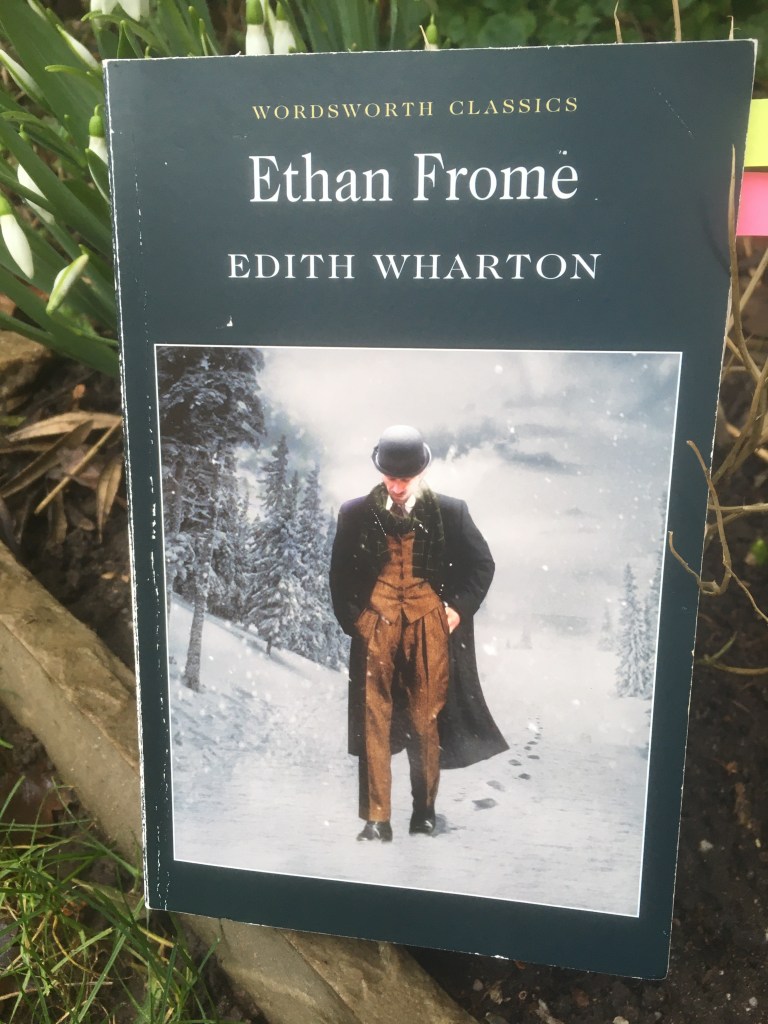
    The Valley of Decision, Edith Wharton’s first published novel in 1902 was set in Eighteenth Century Italy.  At the start of their lifelong friendship, Henry James offered Wharton some constructive criticism after reading this novel, namely she would be better advised to write about what she knew.  Wharton took on board his advice as her next novel, The House of Mirth (1905) presented the trials and tribulations of Lily Bart as she attempts to navigate her way through the upper echelons of New York high society, a world which Wharton knew well.  However, in her 1911 novella Ethan Frome, Wharton takes a different direction again.  Gone are the lavish parties with women in elegant gowns posing in decorous drawing rooms.  In Ethan Frome, the high life of New York is swapped for a lonely snowbound village in western Massachusetts and the harsh living conditions experienced by so-called ordinary folk in the previous century.  I say ‘so-called’ because her novella received a certain amount of criticism for its depiction of working class characters.  Nevertheless, Ethan Frome was greatly admired by Henry James.  Wharton had also set her earlier novel The Fruit of the Tree (1907) in western Massachusetts and would return to the region again in her later novella Summer (1917).

    In an introduction written for the 1922 edition of Ethan Frome Wharton explained she wanted to present something of the ‘harsh and beautiful land’ she had experienced whilst living in the area.  She was implicitly critical of other regional writers such as Sarah Orne Jewett as she felt they idealised the locale, whereas she wanted to create a harsher feeling of ‘the outcropping granite’ of the country.  There is indeed nothing soft and fern-like in her tale of poor Ethan.

    Wharton uses a narrator to frame the story of Ethan whom he meets when he visits the town of Starkfield (note the appropriate name).  As the snow moves in, the unnamed narrator becomes trapped in the isolated small town and this is when Ethan’s story begins to unfold.  The narrator commences by telling the reader:

    I had the story, bit by bit, from various people, and as generally happens in such cases, each time it was a different story. (Prologue)

    The narrator takes shelter in Ethan’s home.  On first meeting Ethan he is struck by his appearance as he was ‘the most striking figure in Starkfield, though he was but the ruin of a man.’ (Prologue).  He looks like an old man and walks with a limp although he was only fifty-two. This was due to an accident some twenty-four years previous. 

    The introductory section functions as a frame narrative, a device often used in gothic stories.  Whilst this is not an overtly gothic tale, it certainly borrows some elements from this genre.  An air of mystery is created surrounding the history of Mr Frome by circling around the story a number of times and using repeated phrases such as ‘most of the smart ones get away.’  Just what has made him a ‘ruin of a man’?  Starkfield is a fictional town, and indeed the carefully chosen name adds to the gothic feel of the location.

    The reader is moved from the Prologue into the main body of the text and this is where the story begins to unfold.  The basic story is relatively straightforward.  A young Ethan Frome inherits the family farm from his father, a farm which was already failing and which takes all of his efforts to sustain.  When his mother becomes ill his cousin Zenobia is sent to help care for her.  On his mother’s death, Ethan’s prospects are bleak and he marries Zenobia (known as Zeena) to stave off the loneliness of winter.  He reflects had it been summer he may not have been so inclined to marry.  From the outset it is not a happy union as Zeena begins to experience one illness after another and becomes completely fixated on what she perceives as her failing health.  Thus, Ethan has replaced a querulous complaining mother for a wife with similar qualities.  Eventually, Zeena’s orphaned cousin Mattie Silver comes to live with them to help out with domestic duties.  She is young, pretty and cheerful and poor Ethan falls in love with her.

    On the surface this is a simple tale, however, it is packed full with psychological intensity.  Wharton biographer Hermione Lee suggests the novella ‘comes as a great shock’ after some of her other novels, not just because of her change of class focus but because of its silence and control.[i]  Although Wharton may more often be associated with her high society novels, she was actually a very diverse and prolific writer.  Her outpourings also included ghost stories, travel literature, war writings, as well as a work on interior design.

    Every reference to Zeena works towards establishing her awful appearance, which soon becomes clear to the reader, is a reflection of her personality.  For example:

    She sat opposite the window, and the pale light reflected from the banks of snow made her face look more than usually drawn and bloodless, sharpened the three parallel creases between ear and cheek, and drew querulous lines from her thin nose to the corners of her mouth.  Though she was but seven years her husband’s senior, and he was only twenty eight, she was already an old woman.  (Chapter Three)

    Zeena constantly complains of various aches and pains and frequently seeks cures from a variety of medications.  It was her so-called failing health which saw a double advantage in giving Mattie a home.  Although Zeena felt obligated to take in her homeless orphaned cousin, she would also provide a source of free labour, allowing Zeena to move further into her chosen role of invalid.

    The arrival of Mattie at the gloomy farmstead is like a breath of fresh air for Ethan.  Whereas the light reflected by the snow emphasized Zeena’s faults, the light from the lamp enhances Mattie’s features:

    … it drew out with some distinctness her slim young throat and the brown wrist no bigger than a child’s.  Then striking upward, it threw a lustrous fleck on her lips, edged her eyes with velvet shade, and laid a milky whiteness above the black curve of her brows.  (Chapter Four)

    The tensions in the home soon begin to rise as the warmth of the attraction between Ethan and Mattie begins to grow.  Zeena becomes ever more critical of Mattie and it is clear the situation will come to a head at some point.  The drama of emotions is tightly controlled and Wharton admitted she was inspired by both The Blithedale Romance by Nathanial Hawthorne and Emily Bronte’s Wuthering Heights with regards to the text’s emotional intensity.

    Much of the writing of Ethan Frome took place during the summer of 1910, a particularly challenging time in Wharton’s life.  Although she was enjoying success in her career, her personal life had become difficult.  Her husband Teddy had for sometime been suffering bouts of ill health and erratic behaviour.  He had previously lost a large sum of Edith’s money due to his uncontrolled actions and by the summer of 1910 he was residing in a clinic.  The doctors in Indiana diagnosed him as having ‘a psychosis’. To complicate matters, Edith was also embroiled in an affair with journalist and author William Morton Fullerton, an affair which was not destined to last.  Later the Wharton marriage would completely breakdown and following her divorce Edith settled permanently in France.

    Interestingly, the French translation of the Ethan Frome bore the title Sous la Neige (Under the Snow) which is actually rather appropriate, not just in terms of the weather, but in the emotions of the characters which seem destined to remain buried.  So, as the weather turns colder and the days grow shorter, why not immerse yourself in some of Wharton’s atmospheric writing.


    [i] Hermione Lee, Edith Wharton, London: Vintage Books, 2008, p.375

  • Pride and Prejudice

    In honour of Jane Austen’s 250th birthday last week, here is my piece on Pride and Prejudice.

    When I first read Pride and Prejudice as a moody fourteen year old, I was far from impressed. I had little interest in the characters, even less enthusiasm for the society in which they lived, and as for the preoccupation with marriage, well that just left me cold.  Some of you dear readers may gasp in horror at such notions.  However, my fourteen year old self was in good company, as Charlotte Brontë also thought Miss Austen was somewhat over-rated. In a letter to her friend, the literary critic G. H. Lewes she asked: ‘Why do you like Miss Austen so very much? I am puzzled on that point.’ On the basis of Lewis’s praise she went ahead and read Pride and Prejudice and delivered her verdict:

    And what did I find? An accurate daguerreotyped portrait of a common-place face; a carefully-fenced, highly cultivated garden with neat borders and delicate flowers – but no glance of a bright vivid physiognomy – no open country – no fresh air – no blue hill – no bonny beck.  I should hardly like to live with her ladies and gentlemen in their elegant but confined houses. (Quoted in Elizabeth Gaskell, The Life of Charlotte Bronte, p.258)

    Ouch. In other words, Jane Austen’s style of writing is controlled, contained and ‘confined’, and one could even say, despite the sophistication of the society presented, it is a little common-place.  That is, if you agree with Miss Brontë.

    The next time I encountered Pride and Prejudice I was a mature undergraduate student and I was not all that enthused as finding this novel on my reading list.  However, after reading the first chapter I experienced a shift in my earlier opinions and was impressed by how much Austen achieves in the space of just a few pages.  Plus I immediately began to appreciate Austen’s humour.

    The opening sentence is one of the most well known beginnings to a novel in English literary history: ‘It is a truth universally acknowledged, that a single man in possession of a good fortune, must be in want of a wife.’  The narrative voice continues to explain that regardless of how much or little is known about said man, such ideas are so powerful ‘he is considered as the rightful property of some one or other of their daughters.’  We are then introduced to Mr and Mrs Bennet and from their ensuing dialogue on the subject of the newly arrived Mr Bingley into the neighbourhood their characters are firmly established.  Mr Bennet appears quick witted and seems to enjoy using his words to toy with his wife. His response to her laying claim on Mr Bingley as a potential husband for one of their daughters is the question ‘Is that his design in settling here?’ Her lack of insight is immediately apparent as she takes his question at face value whilst the reader recognizes his sarcasm.  As their exchange continues Mrs Bennet declares ‘… You take delight in vexing me. You have no compassion for my nerves.’ Her husband’s witty retort once again is not absorbed by her and is again at her expense:

    ‘You mistake me, my dear. I have a high respect for your nerves. They are my old friends. I have heard you mention them with consideration these twenty years at least.’

    Thus, the first chapter establishes the social world of the novel, with its rules and traditions, it introduces some of the significant characters in a mildly humorous way, and in case the reader is in any doubt about Mrs Bennet, concludes by informing us ‘The business of her life was to get her daughters married; its solace was visiting and news.’

    To read the rest of this article please follow the link to the Wordsworth blog by clicking here

  • Louisa Alcott’s Blood and Thunder Tales

    Some years ago I gave a lecture to a local literary society, which I then repeated for the WEA.  The subject was Louisa Alcott’s work outside of Little Women and we explored her love of writing gothic stories, as well as her experiences as a nurse during the American Civil War.  Below is the first half of the lecture which introduces her gothic writing, which she referred to as her ‘blood and thunder tales.’

    Let’s start with a well known beginning:

    “Christmas won’t be Christmas without any presents” grumbled Jo, lying on the rug.

    “Its so dreadful to be poor!” sighed Meg, looking down at her old dress.

    “I don’t think it’s fair for some girls to have plenty of pretty things, and other girls nothing at all,” added little Amy, with an injured sniff. “We’ve got Father and Mother, and each other” said Beth contentedly from her corner.

    You may well recognizable this as the beginning to Little Women, a novel which has not been out of print since its initial publication in 1868.  As well as being a memorable beginning, it is effective in establishing the character types of the four main players:

    • Jo as the focaliser, her personality already coming through as lying on the rug would not have been ladylike behavior in the 19th Century.
    • Meg, the eldest sister, often concerned with her appearance (and frequently frustrated by Jo’s)
    • Petulant Amy, the youngest of the four.
    • And the somewhat saintly and home-loving Beth.

    The Little Women series of novels is the work Louisa Alcott is most remembered for, yet Little Women is the novel she least wanted to write, declaring she didn’t know how to write for girls.  When Little Women was published in 1868, she was more well known for writing lurid gothic thrillers and as the author of Hospital Sketches, a fictionalized account of her experiences as a nurse in the American Civil War.

    Like the eponymous Jo March, Louisa was the second of four sisters, lived most of her life in poverty, and often worked to support her family.  The form of her employment varied from writing, to teaching, to sewing, to working as a companion to wealthier friends and relatives, from which she secured an expenses paid trip to Europe.  The family’s lack of financial stability resulted from the unconventional lifestyle of her parents Amos Bronson and Abba May Alcott.

    Her writing output was prolific – at least 270 works ranging from poetry to novels to essays.  These included 9 novels and 16 short story collections which would now be placed in the genre of young adult fiction; 4 adult novels – Moods (1864), Work (1873), A Modern Mephistopheles (1877), and Diana and Persis (1879).  In addition, she wrote lots of melodramatic gothic works under the gender neutral name A.M. Barnard.

    She called her thrillers her ‘Blood and Thunder tales’.  Themes such as secret family curses, murder, revenge, domineering men, manipulative women, drugs and incest featured in these tales.  These appeared in popular magazines, some were short stories, others were novellas, and most of them were written under her pseudonym A.M. Barnard.

    For many years these works were lost until they were discovered in the Harvard library by scholar Madeleine Stern and rare book collector Leona Rostenberg.  In 1943 on a research visit to the library they realised Louisa Alcott and A.M. Barnard were one and the same.  Their excitement was immense at having discovered these works.  They were not allowed to remove them from the library, instead they had to painstakingly copy all of these works by hand.  Although the discovery was made in 1943, it was not until the 1970s that some of these lost works were re-published.

    One of her longer thrillers – A Modern Mephistopheles, was published anonymously in 1877, after the success of Little Women.  This featured the character Jasper Helwyze who gives hashish to the heroine.  However, most of her thrillers were written before her fame as a way of providing financial support to the family.  These bore titles such as ‘Norna; or The Witch’s Curse’, ‘The Captive of Castile’, ‘The Moorish Maiden’s Vow’, ‘Pauline’s Passion and Punishment’, ‘The Mysterious Key and What It Opened’ and ‘The Abbott’s Ghost or Maurice Treherne’s Temptation.’

    Rather like Jo March in her garret, Louisa wrote stories such as ‘The Rival Prima Donnas’ where a singer takes vengeance by crushing her competitor to death with an iron ring.    Since Louisa’s stories were rediscovered, a number have been collected and republished.  ‘A Marble Woman’ is an eerie tale of domineering males, submissive women, opium addiction and possible incest. Drugs also feature in her work ‘Perilous Play’ where a group of young adults at a picnic experiment with hashish laced candies, almost ending in disaster.

    The Abbot’s Ghost: or Maurice Treherne’s Temptation is set in a haunted English abbey and has quite a Dickensian feel to it.  The cast of characters sit around a hall fire telling ghost stories about haunted houses, coffins and skeletons.  Edith Snowden is Louisa’s strong willed woman with a mysterious past in this tale. ‘A Whisper in the Dark’ was a mystery story about Italian refugees, a spy, and a woman disguised as a man.

    Pauline’s Passion and Punishment is another tale of vengeance with the manipulative protagonist Pauline enacting punishment on her fiancé Gilbert Redmond who breaks off their engagement in order to marry a much wealthier woman. Like many of Alcott’s female characters, Pauline is socially disadvantaged. Although born to a wealthy family, she is reduced to working as a governess.  The plot is highly melodramatic as Pauline enacts a plan to marry a younger man as well as making her former fiancé fall in love with again, simply so she can reject him.  The young sensitive Manuel has fallen in love with her and offers to kill Gilbert, however, she refuses, proclaiming:

    “There are fates more terrible than death, weapons more keen than poniards, more noiseless than pistols… Women use such, and work out a subtler vengeance than men can conceive. Leave Gilbert to remorse and me.”

    She does, however, persuade Manuel to marry her as she needs money in order to finance her revenge. She does not deceive Manuel regarding her motivations though and explains:

    “I want fortune, rank, splendor, and power; you can give me all these… I desire to show Gilbert the creature he deserted no longer poor, unknown, unloved, but lifted higher than himself, cherished, honored, applauded, her life one royal pleasure, herself a happy queen”

    The story is full of suspense which builds during the search for Gilbert and his new bride but I don’t wish to spoil the ending.  The story won a $100 dollar prize in a writing contest which helped with Louisa’s expenses in taking up her post as a Civil War nurse in Washington DC.

    Although Louisa did not publicly acknowledge her blood and thunder stories, and distanced herself through the use of her pen name, letters and journal entries indicate she enjoyed writing them:

    “I think my natural ambition is for the lurid style.  I indulge in gorgeous fancies and wish that I dared inscribe them upon my pages and set them before the public.”

    The main publishers of Louisa’s Blood and Thunder tales were The Flag of our Union as well as Frank Leslie’s Illustrated Newspaper.  In Little Women these become the Blarneystone Banner and Weekly Volcano.  One of her letters stated:

    “I intend to illuminate The Ledger with a blood & thunder tales as they are easy to ‘compoze’ & are better paid than moral works.”

    Indeed, each story earned her between $50-75, which is roughly the equivalent of $2000 – $3000 today. Although the characteristics of these works clearly placed them within the gothic genre, her works are differentiated by her concern with character development.  Gone were the trembling, submissive heroines usually associated with 18th and 19th Century Gothic.  Her works are well worth a read if you like gothic fiction with a more active heroine.  Alcott’s women were strong, even if many of them were evil.

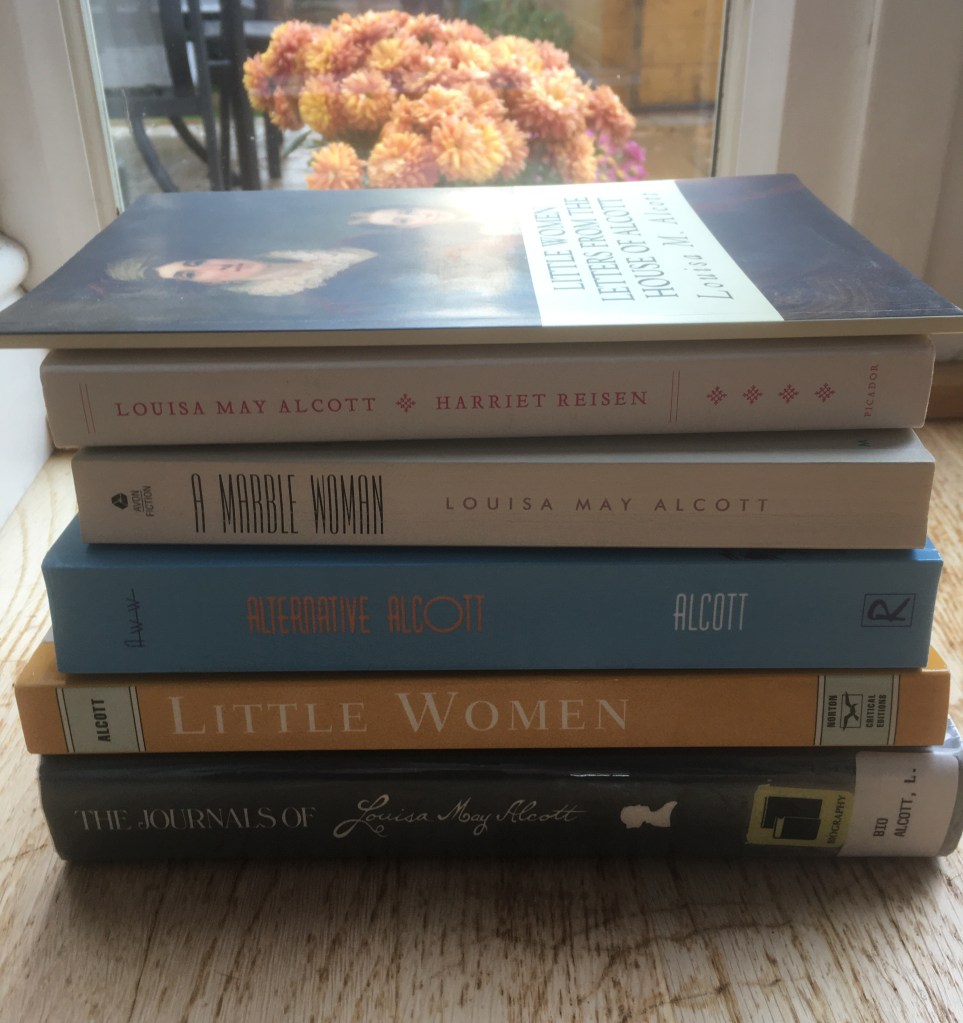
    These are some of the books I found helpful during my research.
  • Man-Size in Marble: A Tale for Halloween

    Halloween is the perfect time for reading ghostly tales. This offering from Edith Nesbit is set at that spooky time of year. Here is an excerpt of my article on her short story ‘Man-Size in Marble’. The full article can be found by following the link to the Wordsworth blog.

    Halloween season, in common with Christmas, is the time of year many an avid reader will reach for a ghostly tale. Whilst sitting comfortably by the fireside hopefully the story will provide just the right amount of gentle chill to the room and a soft breeze to the back of the neck. If this description appeals, ‘Man-Size in Marble’ maybe just the tale you are looking for.

    This story fits the bill in a number of ways, it is set in the period leading up to Halloween, with the climax occurring on that fateful night. The tale is told by a male narrator who immediately alerts the reader that this will not be a happy tale. The opening line sets up an air of mystery: ‘Although every word of this tale is true, I do not expect people to believe it.’ He goes on to reveal: ‘There were three who took part in this; Laura and I and another man. The other man lives still, and can speak to the truth of the least credible part of my story.’ There are indeed some troubling implications established in the first paragraph, however, before exploring the story further, a little background is in order.

    ‘Man-Size in Marble’ was first published in Home Chimes magazine in December 1887 and came from the pen of Edith Nesbit. If that name seems familiar, it is not surprising, as she would later become famous for her highly popular novel The Railway Children (1905) and other children’s fiction including Five Children and It (1902) and The Enchanted Castle (1907). However, in addition to her successful children’s fiction, Nesbit wrote a number of chilling ghost stories for adults, in addition to poetry and other works in collaboration.

    To say Edith Nesbit led a Bohemian life would be somewhat of an understatement. When she married her husband Hubert Bland, she was already seven months pregnant. During their marriage, Bland fathered two children by Nesbit’s friend Alice Hoatson, and Nesbit raised them as her own. Both Nesbit and Bland had affairs and their home in Eltham was lively place with frequent visitors, including such well known names as H.G. Wells.

    Nesbit and her husband were politically active and were the co-founders of the Fabian Society, to which the roots of the Labour party can be attributed. Nesbit and Bland also wrote fiction together under the pseudonym Fabian Bland. If you look carefully, some of her socialist beliefs are apparent in her children’s fiction. Although a politically active woman writer, her attitudes towards the Women’s Suffrage Movement was at best ambivalent and at times directly opposed. Some of Nesbit’s attitudes and beliefs appear to have worked their way into her gothic stories too, along with her lifelong fascination for ghosts.

    To read my discussion of ‘Man-Size in Marble’ please follow the link click here


  • Back to School with Anne of Avonlea

    ‘Oh, will I ever learn to stop and reflect a little before doing reckless things? Mrs Lynde always told me I would do something dreadful someday, and now I’ve done it.’

    Fans of the eponymous orphan Anne Shirley will have probably first encountered her in L.M. Montgomery’s novel Anne of Green Gables, published in 1908. The publishers must have had faith in its potential as Lucy Maud Montgomery was tasked with writing a sequel before the print run of her first novel was completed. Thus, Anne of Avonlea arrived on the shelves in 1909 to great success.

    Anne of Green Gables follows young Anne Shirley from her first arrival at the Cuthbert’s farm brought about by a mistake made by the orphanage where she was formerly residing. Siblings Matthew and Marilla Cuthbert had requested to adopt a boy to help them with the farm work. They are soon both foiled in their intentions to return Anne in favour of the sought after boy, as they become increasingly captivated by the imaginative, talkative young redhead with a fiery temper to match her hair. The novel documents Anne’s exploits and development and at the conclusion she is sixteen years old and has already had to make some difficult decisions. Despite her keen intelligence and potential Anne decides to forego college and remain at home to support an ailing Marilla.

    Anne of Avonlea picks up almost where Anne of Green Gables left off and the narrator informs us ‘Anne is half-past sixteen’ and about to take up her first teaching post at the local school. The novel covers a two year period in Anne’s life, and rather than presenting a sustained linear narrative, the reader is offered a series of incidents and vignettes. Characters from the earlier novel return, along with some well developed new additions. This format provides Maud (as she preferred to be known) with an ideal format in which to not only follow Anne’s growing maturity, but also to address some proto-feminist concerns such as women’s education and marriage. Any evidence of feminism in the text is of the gentle variety though. Anne and her friends form the Avonlea Village Improvement Society of which Anne and her best friend Diana Barry are Secretary and Treasurer whereas the more senior roles of President and Vice President are held by Gilbert Blythe and Fred White. Thus, in this instance, traditional gender roles are maintained.

    Anne’s assertiveness and independence of spirit are evident throughout though. During an angry encounter with their new neighbour Mr Harrison, he calls her a ‘red-headed snippet’. Anne’s customary temper flares and drives her cutting response ‘I’d rather have red hair than none at all except a little fringe around my ears.’ Anne’s tendency to get into scrapes is still present despite being half-past sixteen. An early example is where she accidentally sells the aforementioned Mr Harrison’s cow, believing it to be her own. Despite this incident, Anne’s courage in owning up to her guilt ensures she wins over the cranky Mr Harrison and ultimately they become firm friends.

    … To read the rest of this article, please follow the link to Wordsworth Editions

    <<click here>>

    Leave a comment


  • Elizabeth Gaskell and ‘Wives and Daughters’

    Elizabeth Gaskell died in 1865 leaving behind a wide range of works – novels, novellas, short stories, poetry and non-fiction.  Her final novel, Wives and Daughters lay unfinished, just shy of the final chapter or so.  There is some common ground here between Elizabeth Gaskell and the later writer Edith Wharton, who died before the completing the final chapters of The Buccaneers (1938).  Both writers had their incomplete novels published posthumously.  Both writers decided to set their final works in an earlier time.  Edith Wharton, writing in the 1930s, decided to return to the 1870s in The Buccaneers.  Elizabeth Gaskell, writing in the 1860s, returned to the 1820s in Wives and Daughters.  It is interesting, that at this stage of their lives, both writers decided to revisit a bygone age.

    In some ways it is difficult to know where to start with Wives and Daughters.  It is a large, and in some ways, a complex novel spanning some 580 plus pages.  At the heart of the novel is the story of young Molly Gibson and her journey from childhood into maturity and the relationships she forms with those around her.  However, in many ways, this is an oversimplification of a very rich text.  Gaskell explores some complex issues and the novel contains many carefully drawn characters.  It features not only birth, marriage and death, but secrets and lies, conflict and humour, and is much more than a simple tale of Molly’s maturation.  It opens in a fairytale like manner:

    To begin with the old rigmarole of childhood. In a country there was a shire, and in that shire there was a town, and in that town there was a house, and in that house there was a room, and in that room there was a bed, and in that bed there lay a little girl; wide awake and longing to get up, but not daring to do so for fear of the unseen power in the next room…

    The ‘unseen power’ is Betty the maid, and the little girl is the aforementioned Molly.  The ‘sing-song’ rhythmic nature and the use of repetition is a little like a nursery rhyme, but it also achieves an image which moves from a wide view to a specific focus. Whether you find this opening endearing or a little off-putting, please forge ahead as you will not be disappointed.

    …To read the rest of the article (free) please follow the link to Wordsworth Editions click here

    Leave a comment

    Leave a comment

  • The Shadowy World of Edith Nesbit

    Recently, I was fortunate to have a very small involvement with some bibliography research regarding the newly published Wordsworth collection of Edith Nesbit’s ghost stories. I also wrote a blog discussing some of her ghostly tales which you can read an excerpt of below. If you would like to read the full article, just follow the link in the usual way.

    Chances are, many readers know Edith Nesbit from her creation of courageous Bobbie in the successfully adapted 1905 novel The Railway Children.  Or, possibly your first introduction was through the mysterious creature the Psammead in Five Children and It (1902), or perhaps the adventures of Jerry, Jimmy and Kathleen in The Enchanted Castle (1907).  Therefore, some may be surprised to find images such as the following, flowing from the same pen:

    … So he went upstairs, and at the door of the first bedroom he came to he struck a wax match, as he had done in the sitting rooms.  Even as he did so, he felt that he was not alone.  And he was prepared to see something but for what he saw he was not prepared.  For what he saw lay on the bed, in a white loose gown – and it was his sweetheart, and its throat was cut from ear to ear.

    This excerpt comes from Nesbit’s short story ‘The Mystery of the Semi-Detached’ included in her 1893 collection Grim Tales.  In just a few lines she moves from creating a vague sense of unease to a startling shock.  To say this is characteristic of Nesbit’s gothic writing is an oversimplification as she wrote many and varied short stories which could be categorized under the umbrella of horror.  Whilst there are distinct similarities regarding some aspects of style and thematics across her tales, there is also a rich variety and this sense of variety is exemplified by the newly published Wordsworth Edition Man-size in Marble and Other Grim Tales.

    Nesbit is not alone in being better known for other forms of writing, despite producing a significant amount of material in the horror genre.  Writers such as Charles Dickens, Elizabeth Gaskell, Edith Wharton, Henry James and E.F. Benson all had notable forays into the realms of gothic despite being more usually associated with other forms of writing.  Yet Nesbit wrote a large number of horror stories during the course of her writing career, although it is sometimes wrongly assumed this was simply something she did until her children’s stories made her famous.  Her horror works span from the late Victorian era of the 1880s up until the post First World War period, with her final story ‘The Detective’ appearing in 1920.

    Many of her stories made their first appearance in popular journals of the day such as Longman’s Magazine, Temple Bar, Windsor, and London MagazineThe Strand Magazine, famous for its longstanding publication of Sir Arthur Conan Doyle’s Sherlock Holmes stories, also published many of Nesbit’s tales.  She collected some of her short stories together in several volumes, beginning with the previously mentioned Grim Tales and Something Wrong in 1893.  The Wordsworth Edition of her tales is unusual as it not only reproduces the Grim Tales collection in its entirety, but also includes all of her other horror stories, many of which have previously been overlooked.

    Stephen Carver’s Introduction to the collection discusses how biographies and other secondary writings about Nesbit’s work tend to focus on her children’s fiction, whilst her horror stories tend to be dismissed.  The Radio 4 programme Great Lives devoted an episode to Edith Nesbit on 22 April 2024.  She was chosen by children’s writer Katherine Rundell who praised her for continuing to inspire children’s fiction today.  Biographer Elisabeth Galvin joined the discussion and posited that Edith began writing through necessity as a young mother in order to help support the family.  At that time her husband Hubert Bland was very ill, almost dying from smallpox.  To compound matters his business collapsed when his partner absconded to Spain with all of their money.  Thus, she would sit up late into the night writing what Galvin described as ‘her hack stories for newspapers.’  Galvin is not alone in viewing Nesbit’s gothic work in this way and it is difficult to ignore the negative connotations imbedded in such a term.  The word ‘hack’ originates from Hackney Carriage, a form of transport available for hire.  Thus a ‘writer for hire’, namely someone who produces large amounts of writing quickly to earn money, may well be viewed in negative terms.  Similarly, genre fiction, for example horror and science fiction may also be dismissed as being popular, not highbrow or literary and thus unlikely to be art or to put forward important ideas.  Clearly, this is a rather traditional, and some may say outdated stance, but may well explain why Nesbit’s horror stories have attracted little critical attention.  A few of her stories have been anthologised over the years, most commonly ‘Man-size in Marble’ as well as ‘John Charrington’s Wedding’ and ‘The Ebony Frame’.

    Elisabeth Galvin’s biography of Nesbit does make mention of her horror stories, and unusually finds value in them, a position with which I agree.  Galvin suggests they originate from the mind of someone who was unhappy, and if you follow the details of her life, this may well seem true.  However, she states Nesbit should be ‘applauded for her pioneering ghost stories that were several degrees chillier than anything that had been written before.’  Nesbit does indeed develop a considerable amount of chill in her stories.  Whilst there are some similarities and recurring images, there are distinct differences too.  Sometimes there is a logical explanation for what initially appeared to be supernatural, other times the horror is unapologetically supernatural in origin.  Unusually for a lady writer of the time, many of her narrators are male, and not all of them are heroic.  The Wordsworth collection nicely exemplifies the range of her horror writing.  A few of the stories are quite humorous and playful, offering a little light relief from the darkly gothic tales, not all of which have happy endings.  Other stories defy expectations such as ‘The Haunted House’ first published in The Strand Magazine in 1913.  As its name suggests, this starts out as a haunted house tale, whereby the male protagonist answers an advertisement to investigate strange phenomena and arrives ‘in front of a white house with bare, gaunt windows.’  However, this is a story which shifts the ground beneath the reader as the narrative progresses.  How?  Well, you will need to read it to find out.

    To read the rest of this article, please follow the link to Wordsworth Editions Click here

    Leave a comment

  • Sherlock Holmes in 1924

    This is from my Wordsworth Blog written last year to commemorate three Sherlock Holmes stories written in 1924. Sherlock Holmes is one of my favourites and I am sure to write more on his antics in the future.

    Sherlock Holmes fiction probably conjures up images of fog bound London streets, hansom cabs and cosy scenes in 221b Baker Street with its Victorian décor.  However, this year marks the centenary of the publication of three particular Sherlock Holmes short stories and it may seem strange to think of Sherlock Holmes in the 1920s.  ‘The Adventure of the Sussex Vampire’ was first published in The Strand Magazine in January 1924.  This was followed by ‘The Adventure of the Three Garridebs’ in the American magazine Colliers in October 1924, later appearing in The Strand Magazine in January 1925.  Colliers also featured ‘The Adventure of the Illustrious Client’ in November 1924 and once again The Strand Magazine followed in suit in February – March 1925.

    It seems to be taken as a given by Holmes aficionados that the quality of Conan Doyle’s earlier Holmes stories far outweigh those produced later in his life.  The final collection of stories The Casebook of Sherlock Holmes, which includes the three aforementioned stories, does indeed contain some of the weaker tales in terms of plotting and solution.  This collection is discussed by the late David Stuart Davies in his Wordsworth blog of 5 June 2020, and as he suggests, many of the stories have a somewhat darker edge.

    I thought it might be interesting to cast a tighter focus on these three stories as this year marks their centenary.  How then, does Conan Doyle locate Holmes within the decade of the 1920s?  Well, the answer is, that he largely avoids doing so. One of the ways around this is to have the stories told in retrospect, indeed two of the three stories are set in 1902 which allows Conan Doyle to keep that familiar feel.  Let’s move to consider each of the stories in turn.

    To read my discussion of ‘The Sussex Vampire’, ‘The Three Garridebs’ and ‘The Illustrious Client’ please follow the link to the Wordsworth blog Click here.