Tag: fiction

  • Jane Austen, Persuasion and Lyme Regis

    The Austen family visited Lyme Regis in the Autumn of 1803 and again in the summer of 1804.  At the time of their visit, Lyme Regis was fast becoming a popular destination for middle class Georgians to enjoy the healing properties of bathing and the sea air.

    Historian Lucy Worsley in her research for her work Jane Austen at Home managed to track down where the Austens stayed for part of their summer sojourn, and identifies it as Pyne House in Broad Street.  The house, now divided into holiday flats, still exists and Lucy Worsley stayed there during the course of her research.  Although it seems that Jane Austen did not return to Lyme Regis after 1804, her time there clearly made a firm impression on her as she later used the setting in her final completed novel, Persuasion.

    Characters are rarely static in Austen’s work, frequently moving between locations, and Persuasion is no exception.  Anne Elliot, the heroine of the text, moves between three significant settings.  The novel begins in rural Somersetshire.  There is an interlude in Lyme Regis.  The novel then concludes in Bath.  It is the section in Lyme Regis which interests me, although my use of the term ‘interlude’ may not be the most accurate word.  Whilst constituting a relatively small portion of the novel, it is this section which proves transformative for Anne, in part through the symbolic nature of the landscape.  However, before we arrive at Lyme Regis it may be useful to establish a little bit of context.

    The novel tells the story of twenty-seven year old Anne Elliot, rather an elderly spinster by Regency standards, who, we are frequently told, is now losing her bloom.  We encounter Anne some eight years after her broken engagement to Frederick Wentworth, who was a Lieutenant of limited financial means.  The broken engagement has occurred before the beginning of the novel and the reader has to piece together the details as the novel unfolds.  Anne was persuaded to end the engagement through family pressure due to concerns about Wentworth’s lower status.  During the eight years which have passed, no potential suitors have generated the same depth of feeling and thus Anne may well be facing life as an old maid.  To compound matters further, the Elliots have seen a decline in their fortunes due to reckless money management by Anne’s father.  They have no choice but to rent out the family home of Kellynch Hall.  Thus, the widowed Sir Walter and Anne’s older and unmarried sister Elizabeth set up residence in Bath.  Meanwhile, Anne goes to live with her younger married sister Mary at Upper Cross.  Kellynch Hall is rented out to Admiral Croft following his return from the Napoleonic Wars.  His wife just happens to be the sister of Frederick Wentworth (he of the broken engagement) thus making way for his return into Anne’s life.  Whilst the Elliot fortunes have declined, Wentworth is now a wealthy Captain.  He remains angry and bitter over the end of the relationship, and any reconciliation seems unlikely, making the usual Austen happy ending doubtful.

    On the surface, Anne Elliot appears a more reserved and introverted Austen heroine but her development is connected to the locations in which she finds herself.  Just under half way through the novel a visit to Lyme Regis is proposed and thus Anne finds herself joining a party consisting of her sister Mary and husband Charles, and his sisters Henrietta and Louisa.  Captain Wentworth is also part of the group and seems to be engaging in some mild flirtation with Louisa.

    Passing time is a recurrent theme in the novel, not least due to the frequent references to Anne’s fading youth.  The sense of lateness is continued during the visit to Lyme Regis.  It is November, and so the holiday season is over: ‘…the rooms were shut up, the lodgers almost all gone, scarcely any family but of the residents left.’ It being November, the daylight is fast fading and the narrator tells us ‘… it was very evident they would not have more time for looking about them, before the light and warmth of the day were gone.’ (Chapter Eleven). This somewhat melancholy feel is extended through Anne’s sense of regret at what might have been regarding Captain Wentworth, and Lyme Regis becomes a place for reflection.  However, the location quickly works its magic as Anne begins to enjoy herself and becomes more confident as she begins to appreciate her own intelligence.  The following morning, she partakes of a ‘stroll down to the sea before breakfast’ (Chapter Eleven) in the company of Henrietta.  The narrator describes how Anne glories in the delight of the sea breeze.  Later that morning Anne accompanies Captain Wentworth, Louisa and Henrietta on a trip to town.  It is on the way back that a significant event occurs in terms of Anne’s transformation.  As they are about to descend the steps leading down to the beach they encounter a gentleman who draws back to allow them to go first.  As they pass by, the gentleman looks at Anne:

    … with a degree of earnest admiration which she could not be insensible of.  She was looking remarkably well; her very regular, very pretty features, having the bloom and freshness of youth restored by the fine wind which had been blowing on her complexion, and by the animation of eye which it had also produced. (Chapter Twelve)

    This is the first instance of Anne’s appearance being described in favourable terms.  The moment becomes more significant though:

    It was evident that the gentleman (completely a gentleman in manner), admired her exceedingly.  Captain Wentworth looked round at her instantly in a way which showed his noticing of it.  He gave her a momentary glance – a glance of brightness, which seemed to say, ‘That man is struck with you – and even I, at this moment, see something like Anne Elliot again.  (Chapter Twelve)

    This is an important moment.  Not only has the vigour of the sea air restored Anne’s fading bloom, Captain Wentworth is witness to another man finding her attractive, which begins a shift in his own feelings.
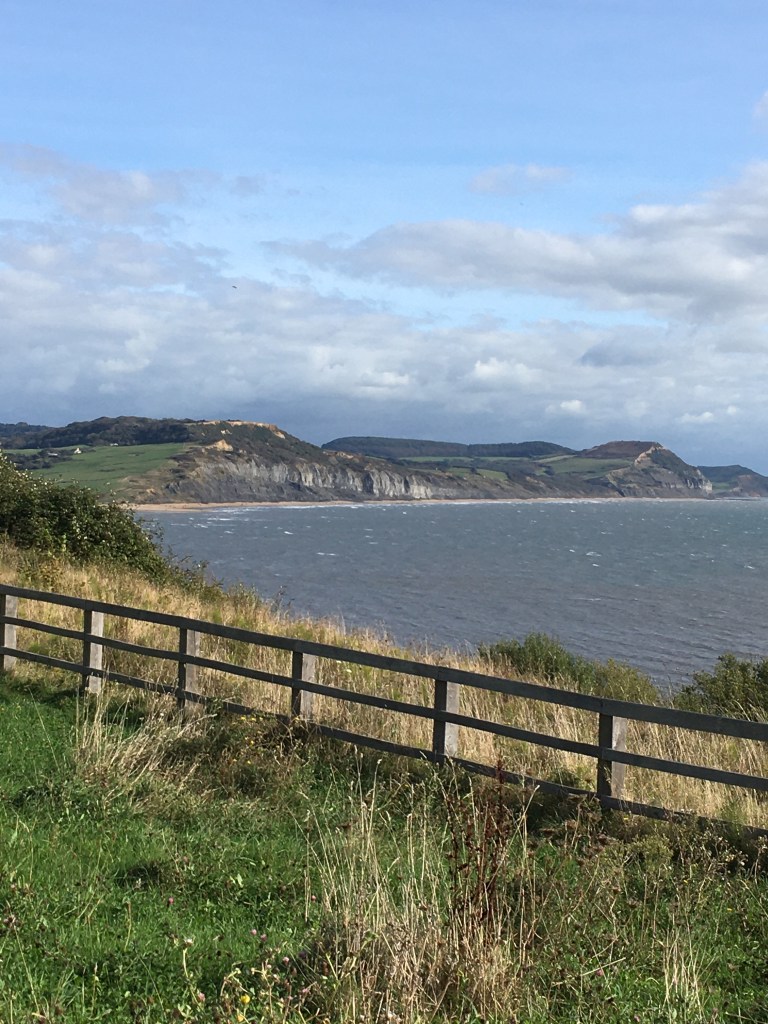
    The next significant event concerns an accident at the Cobb.  This is a stone constructed breakwater and jetty, some of which dates back to medieval times.  It has proved to be an important structure over the years, preventing coastal erosion and securing a safe harbour for trade, and thus is of great economic importance for the town.  It has been extended and repaired many times over the centuries.  Earlier, the narrator has praised ‘its old wonders and new improvements, with the very beautiful line of cliffs stretching out to the east of the town,’ a description which is still recognisable today.  Jane Austen’s fondness for Lyme Regis is evident through the way in which she creates a sense of the surrounding scenery.

    The rather boisterous Louisa has previously enjoyed being jumped down from stiles by Captain Wentworth as ‘the sensation was delightful to her.’  Whilst the other ladies are content to use the steps from the high part of the Cobb to the lower level, Louisa again wishes to be jumped down.  Wentworth is reluctant to do so, fearing the hardness of the pavement will be too jarring for her.  She refuses to listen, he reluctantly agrees, and all is well.  That is until she runs up the steps to be jumped down again.  This time she jumps too soon and he fails to catch her, ‘she fell on the pavement on the lower Cobb, and was taken up lifeless!’ (Chapter Twelve) Her face is described as ‘like death’.  Chaos ensues, her sister Henrietta faints and Wentworth is beside himself with guilt and despair.  It falls to Anne to take control, providing smelling salts, supporting the fainting sister, and insisting a surgeon is sent for.  As the drama continues, Anne remains a figure of calm and it becomes clear Wentworth defers to her authority and begins to appreciate, rather than resent, her presence.

    Lyme Regis functions as a place of transition.  In terms of structure, it occupies a small space in the narrative, just two chapters at the end of Volume I, providing an interlude between the rural Somersetshire chapters in Volume I and the Bath chapters in Volume II.  However, it provides a crucial turning point in the story of Anne Eliot.  She gains a newfound confidence regarding her intellectual strengths, and experiences moments of self-realisation regarding her own actions in the broken engagement to Wentworth.  Furthermore, her physical health is improved by the sea air and she regains some of her lost, all important, bloom.  The narrator describes it as an ideal place ‘for sitting in unwearied contemplation’.  Indeed, Austen’s love for the location clearly comes through as we are told ‘these places must be visited, and visited again, to make the worth of Lyme understood.’ (Chapter Eleven) As we leave Anne Elliot just half way through her story, you could now turn to Persuasion to see how her future unfolds.

    (Photos are author’s own)
  • Henry Dunbar by Mary Elizabeth Braddon

    I have read a number of books by Mary Elizabeth Braddon, and this one I enjoyed more than some of the others.  For a writer of sensation novels who produced more than eighty books, only one of her works seems to get most of the attention, and that is Lady Audley’s Secret.  It is indeed a fine text, and a prime example of everything which made the sensation novel such a success in the mid-Victorian period, but it is a pity most of her other works tend to be overlooked.

    Like many of her works, Henry Dunbar first appeared in serialized form under the title The Outcasts.  Installments in the London Journal began in September 1863 and concluded in March 1864. Braddon’s ‘husband’ and agent John Maxwell was unhappy with the sum offered by Tinsleys, publishers of her previous novels and as they refused to increase their fee, this became the first of Braddon’s novels to be published by Maxwell.  If you are wondering why the marital status is in inverted commas, this is because they were not actually married.  They were living together as husband and wife, but Maxwell’s actual wife was still alive and living in Ireland.  I have written about this in my previous blog post on ‘Eveline’s Visitant’

    The tale begins with the young Henry Dunbar and Joseph Wilmot employed in a London Banking House.  Dunbar manages to run up large gambling debts and convinces his friend Wilmot, who happens to have a talent for ‘copying’ handwriting, to create some forged bonds in order to pay off his debtors, claiming Wilmot will be rewarded.  However, the crime is discovered and Dunbar lays the blame squarely on the gullible Wilmot.  The owner of the bank, Dunbar’s uncle, banishes him to their Indian office and fires Wilmot.  Poor Joseph Wilmot is unable to find respectable work due to the scandal and falls into a life of crime, which ultimately results in him being transported to Tasmania.  He blames Dunbar for his misfortunes, as does his daughter Margaret.  Years pass and following his release, Wilmot and his daughter live under the assumed name of Wentworth.  Henry Dunbar returns from exile to inherit the family business and become a very wealthy man.  In true Braddon style, there is high drama and many twists and turns follow.

    However, there is more to this text than just the usual melodrama, evidence by some of the criticism it received on publication.  Jennifer Carnell, in her excellent work The Literary Lives of M.E. Braddon writes of how contemporary critics gave negative reviews and accused Braddon of glorifying criminals through her depictions of villains.  I agree with Carnell who disputes this, suggesting Braddon does not sympathise with crime, but instead seeks to explain it.  It is hopefully not too much of a spoiler, as this happens early in the novel, but Wilmot confronts Dunbar on his return to England, following which, Wilmot disappears.  This makes way for a move into the realms of detective fiction as Margaret strives to ascertain what has happened to her father.

    There are many qualities in Braddon’s writing, one of which is her ability to evoke a sense of place.  After the initial dramatic reunion between the two men, they appear to reconcile, although it is apparent to the reader that the reconciliation is false on both sides.  They dine at The Dolphin Hotel in Southampton, a place which still exists and has a long history as a famous coaching Inn.  They travel to Winchester where Wilmot is to be the guest of Dunbar at The George, another famous coaching Inn which has since been demolished.  Braddon writes of their sojourn:

    They walked under the shadow of a low stone colonnade, and then turned aside by the market-place, and made their way into the precincts of the cathedral.  There are quaint old courtyards, and shadowy quadrangles hereabouts; there are pleasant gardens, where the flowers seem to grow brighter in the sanctified shade than other flowers that flaunt in the unhallowed sunshine.  (Chapter 8)

    Not only does Braddon create a remarkable sense of place here, but I also cannot help but think she is making a symbolic point through her description of the flowers.

    Real places continue to be evoked as the narrator refers to the two men strolling from the cathedral towards St Cross and the Water Meadows.  They are due to dine together later, but Joseph Wilmot has disappeared, and his body is later discovered.

    There are several detectives seeking the truth in this novel, both official and unofficial, and the dialogue Braddon creates during the Inquest reads like an early precursor to the genre of the courtroom drama.  Scotland Yard become involved through the character of detective Mr Carter.  Arthur Lovell, a young lawyer also joins the investigation and his pursuits are described in detail, but it is Margaret who is relentless in her search for the truth.  Wilkie Collins, a contemporary of Braddon is much more well known and is often referred to as the father of the British detective novel through his work The Moonstone (1868).  With Henry Dunbar appearing four years earlier, maybe Braddon could be thought of as the mother of the detective novel.

  • The Classics Club Spin #44

    This will be my first time taking part in the Classics Club Spin. What is this? Well, you create a list which includes 20 titles from your main Classics Club Challenge list. On Sunday 17th May they will post a number from 1 to 20. The challenge is to read whatever book falls under that number by 5th July 2026. This is my list:

    • 1. Jane Austen, Persuasion
    • 2. Dorothy Bowers, Fear for Miss Betony
    • 3. Mary Elizabeth Braddon, Henry Dunbar
    • 4. Christianna Brand, Green for Danger
    • 5. L. M. Montgomery, Anne of Windy Poplars
    • 6. Frances Hodgson Burnett, The Making of a Marchioness
    • 7. Anne Bronte, The Tenant of Wildfell Hall
    • 8. Sir Arthur Conan Doyle, His Last Bow
    • 9. John Galsworth, The Man of Property
    • 10. Elizabeth Gaskell, Ruth
    • 11. Anna Katherine Green, The Circular Study
    • 12. Henry James, The Turn of the Screw
    • 13. E.C.R. Lorac, Fell Murder
    • 14. Gladys Mitchell, Laurels are Poison
    • 15. Edith Nesbit, The Lark
    • 16. May Sinclair, Mary Olivier: A Life
    • 17. Josephine Tey, The Francise Affair
    • 18. Anthony Trollope, Barchester Towers
    • 19. Patricia Wentworth, Ladies Bane
    • 10. Mary Westmacott, Absent in the Spring

  • Agatha Christie, Dead Man’s Folly and Greenway House

    Many of the country house settings found in classic crime fiction are now the kind of stately homes you might find on a visit to a National Trust property.  The connection between the two becomes ever stronger regarding the novel Dead Man’s Folly and Greenway House in Devon.  Both form part of the extensive heritage left by one of the most famous crime writers, Agatha Christie.

    Dead Man’s Folly, published in 1956, began life as a shorter text, ‘The Greenshore Folly’.  Agatha Christie wrote it in 1954 with the intention of donating the rights to Churston Fetters Church to raise money for new stained glass windows.  However, the story was difficult to sell as it was too long for a short story but not long enough for a novel.  Never one for waste, Christie turned part of the text into a short story, ‘Greenshaw’s Folly’, featuring Miss Marple, which she gave to the church.  She then produced a longer work which we now know as the Hercule Poirot novel Dead Man’s Folly.  The ‘Greenshaw’ of the earlier incarnation may have provided a clue regarding the setting as she drew inspiration from her beloved holiday home Greenway House in Devon.  Names were changed though.  The river Dart became the river Hel, and Greenway House became Nasse House.   Christie had drawn upon her Devon home in other novels – Five Little Pigs, Ordeal by Innocence and Towards Zero.  However, it is in Dead Man’s Folly that the house and grounds are most clearly evoked.

    Agatha Christie bought Greenway House in 1938 during what she described as her ‘plutocratic period.’  It was advertised in Country Life where it was described as “suitable for a first class hotel.”  Lucy Worsley, in her biography Agatha Christie: A Very Elusive Woman, highlights how remarkable such a purchase was, as at this point in time most large country houses were being sold off, and not being bought as private residences.  This is reflected in Dead Man’s Folly where the former lady of the manor Mrs Folliat, who now lives in the lodge by the front gate declares:

    Nice to have Nasse lived in again.  We were all so afraid it was going to be a hotel… One drives through the country and passes place after place with the board up “Guest House” or “Private Hotel”… All the houses one stayed in as a girl – or where one went to dances.  Very sad.  (Chapter 5, p.62)

    Christie’s initial enjoyment of Greenway was short lived as when the Second World War began the house was commandeered by the Admiralty and not returned to her until February 1945.  Her love for the house is clear from her own autobiographical writings, as well as the way it is evoked in her previously mentioned works of fiction.

    Dead Man’s Folly begins with Hercule Poirot receiving a call for help from his good friend the famous crime writer, Ariadne Oliver.  Mrs Oliver is staying at Nasse House in Devon, which is the home of Sir George and Lady Stubbs.  She has been tasked with devising a Murder Hunt for their garden fete, but her intuition leads her to tell her old friend “But I think there’s something wrong.” (Chapter 1, p.11) There is a form of doubling occurring in the text as the grounds of Nasse House is the setting for a murder mystery style treasure hunt, and subsequently becomes the scene of an actual murder.  Ariadne Oliver is indeed right, her plans are being manipulated.

    I am not sure if it is because I am familiar with Greenway following my visit, and thus have firm images in mind, or whether Christie’s love of the house is coming through, but this text feels particularly evocative regarding location and sense of place.  This begins with Hercule Poirot’s chauffeur driven arrival:

    They went on, down a steep hill through woods, then through big iron gates, and along a drive, winding up finally in front of a big white Georgian house looking out over the river.  (Chapter 1, p.8)

    The grounds with its many interesting features and self-contained areas provides the perfect setting for a treasure hunt style murder mystery, as seen by Poirot’s attempts at navigating his way through the clues:

    … Poirot went off murmuring to himself like an incantation: Tennis Court, Camelia Garden, The Folly, Upper Nursery Garden, Boathouse…

    The event of the Summer Fete helps in providing the usual cast of suspects required in any classic murder mystery as Sir George and Lady Stubbs have a number of guests staying with them.  In addition, the house next door has been converted into a Youth Hostel providing a few additional suspects in the guise of trespassers.  Added to the mix, as well as a murder, there is a disappearance and an unexpected arrival of a long lost relative.  Thus, there is plenty to keep the reader engaged, and some quality Christie plotting.

    At this point, it is worth returning to Ariadne Oliver, a character who appears in several Christie novels and who the author admits is partly based on herself.  Christie has been known to use this character in particular ways, sometimes to make comment on the process of writing.  Indeed, she is already tired of her detective character Sven and regrets making him Finnish as she has never been to Finland and knows nothing about the country.  There are echoes here of Christie’s creation of the Belgian Poirot!  When attempting to explain the plot of her treasure hunt the brilliant Poirot blinks “in mute incomprehension.” (Chapter 4, p.38).  She bemoans the need to explain her story as she prefers to write things down as verbally explaining her plots always ends in “the most frightful muddle.” (p.40) Poirot says nothing but privately reflects the “whole plot and action of the Murder Hunt seemed to be wrapped in impenetrable fog.” (p.41) Fortunately Christie’s plot, whilst requiring careful attention, is somewhat clearer.

    It is interesting though, that a novel set in her home, also contains some further personal reflections.  Ariadne Oliver is used to such effect during the treasure hunt where she encounters a competitor:

    ‘They say Mrs Ariadne Oliver is down here herself somewhere about. I’d like to get her autograph. You haven’t seen her about, have you?

    ‘No’, said Mrs Oliver firmly.

    ‘I’d like to meet her. Good yarns she writes.’ He lowered his voice. ‘But they say she drinks like a fish.’

    He hurried off and Mrs Olive said indignantly: ‘Really! That’s most unfair when I only like lemonade.’  (Chapter 6, p.77)

    This is based on an exchange Christie overheard between two women, whilst keeping her identity secret.  They praised her writing but commented they had heard she drinks like a fish.  Rather than being offended, she was mildly amused.  Agatha Christie was T-total, and her drink of choice was cream.

    Whilst she may have slightly altered the above anecdote, much of the detail related to the house and grounds remain, as does the history of the house as told by Mrs Folliat.  Even Poirot’s bedroom has a basis in reality as he is led up “the staircase and along a passage to a big airy room looking out over the river.” (p.42) The bathroom opposite reflects the geography of the interior.  Beyond the house there is the Gate Lodge, Ferry Cottage, the Tennis Court, the Battery (where he encounters Mrs Oliver on his arrival) and the Boathouse.  The latter is carefully described:

    A short steep slope led down to the door of the boathouse which was built out over the river, with a little wharf and a storage place for boats underneath.  (Chapter 6, p.79)

    This location is particularly significant as it is the scene of the murder in Mrs Oliver’s plot and, as you might have guessed, becomes the scene of the real crime.  The beauty of the backdrop provides an apposite contrast for brutality of the events.  Even Poirot, who is not fond of “nature in the wild” finding it too untidy and unruly found the “beauty of Nasse House appealed to him in spite of himself.” (Chapter 16, p.194)  The ITV 2012 adaptation of Dead Man’s Folly starring David Suchet was actually filmed at Greenway.  It seems even more fitting that this was the final episode of Poirot to be filmed at such a significant location.

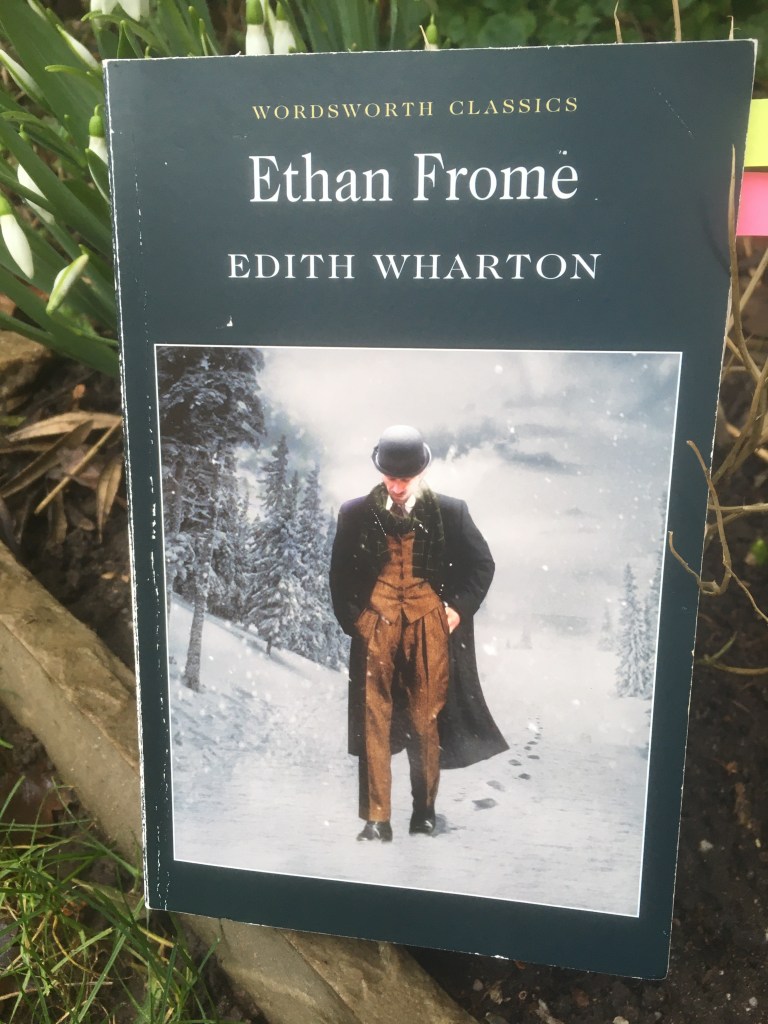
  • Ethan Frome, or ‘Sous la Neige’

    The Valley of Decision, Edith Wharton’s first published novel in 1902 was set in Eighteenth Century Italy.  At the start of their lifelong friendship, Henry James offered Wharton some constructive criticism after reading this novel, namely she would be better advised to write about what she knew.  Wharton took on board his advice as her next novel, The House of Mirth (1905) presented the trials and tribulations of Lily Bart as she attempts to navigate her way through the upper echelons of New York high society, a world which Wharton knew well.  However, in her 1911 novella Ethan Frome, Wharton takes a different direction again.  Gone are the lavish parties with women in elegant gowns posing in decorous drawing rooms.  In Ethan Frome, the high life of New York is swapped for a lonely snowbound village in western Massachusetts and the harsh living conditions experienced by so-called ordinary folk in the previous century.  I say ‘so-called’ because her novella received a certain amount of criticism for its depiction of working class characters.  Nevertheless, Ethan Frome was greatly admired by Henry James.  Wharton had also set her earlier novel The Fruit of the Tree (1907) in western Massachusetts and would return to the region again in her later novella Summer (1917).

    In an introduction written for the 1922 edition of Ethan Frome Wharton explained she wanted to present something of the ‘harsh and beautiful land’ she had experienced whilst living in the area.  She was implicitly critical of other regional writers such as Sarah Orne Jewett as she felt they idealised the locale, whereas she wanted to create a harsher feeling of ‘the outcropping granite’ of the country.  There is indeed nothing soft and fern-like in her tale of poor Ethan.

    Wharton uses a narrator to frame the story of Ethan whom he meets when he visits the town of Starkfield (note the appropriate name).  As the snow moves in, the unnamed narrator becomes trapped in the isolated small town and this is when Ethan’s story begins to unfold.  The narrator commences by telling the reader:

    I had the story, bit by bit, from various people, and as generally happens in such cases, each time it was a different story. (Prologue)

    The narrator takes shelter in Ethan’s home.  On first meeting Ethan he is struck by his appearance as he was ‘the most striking figure in Starkfield, though he was but the ruin of a man.’ (Prologue).  He looks like an old man and walks with a limp although he was only fifty-two. This was due to an accident some twenty-four years previous. 

    The introductory section functions as a frame narrative, a device often used in gothic stories.  Whilst this is not an overtly gothic tale, it certainly borrows some elements from this genre.  An air of mystery is created surrounding the history of Mr Frome by circling around the story a number of times and using repeated phrases such as ‘most of the smart ones get away.’  Just what has made him a ‘ruin of a man’?  Starkfield is a fictional town, and indeed the carefully chosen name adds to the gothic feel of the location.

    The reader is moved from the Prologue into the main body of the text and this is where the story begins to unfold.  The basic story is relatively straightforward.  A young Ethan Frome inherits the family farm from his father, a farm which was already failing and which takes all of his efforts to sustain.  When his mother becomes ill his cousin Zenobia is sent to help care for her.  On his mother’s death, Ethan’s prospects are bleak and he marries Zenobia (known as Zeena) to stave off the loneliness of winter.  He reflects had it been summer he may not have been so inclined to marry.  From the outset it is not a happy union as Zeena begins to experience one illness after another and becomes completely fixated on what she perceives as her failing health.  Thus, Ethan has replaced a querulous complaining mother for a wife with similar qualities.  Eventually, Zeena’s orphaned cousin Mattie Silver comes to live with them to help out with domestic duties.  She is young, pretty and cheerful and poor Ethan falls in love with her.

    On the surface this is a simple tale, however, it is packed full with psychological intensity.  Wharton biographer Hermione Lee suggests the novella ‘comes as a great shock’ after some of her other novels, not just because of her change of class focus but because of its silence and control.[i]  Although Wharton may more often be associated with her high society novels, she was actually a very diverse and prolific writer.  Her outpourings also included ghost stories, travel literature, war writings, as well as a work on interior design.

    Every reference to Zeena works towards establishing her awful appearance, which soon becomes clear to the reader, is a reflection of her personality.  For example:

    She sat opposite the window, and the pale light reflected from the banks of snow made her face look more than usually drawn and bloodless, sharpened the three parallel creases between ear and cheek, and drew querulous lines from her thin nose to the corners of her mouth.  Though she was but seven years her husband’s senior, and he was only twenty eight, she was already an old woman.  (Chapter Three)

    Zeena constantly complains of various aches and pains and frequently seeks cures from a variety of medications.  It was her so-called failing health which saw a double advantage in giving Mattie a home.  Although Zeena felt obligated to take in her homeless orphaned cousin, she would also provide a source of free labour, allowing Zeena to move further into her chosen role of invalid.

    The arrival of Mattie at the gloomy farmstead is like a breath of fresh air for Ethan.  Whereas the light reflected by the snow emphasized Zeena’s faults, the light from the lamp enhances Mattie’s features:

    … it drew out with some distinctness her slim young throat and the brown wrist no bigger than a child’s.  Then striking upward, it threw a lustrous fleck on her lips, edged her eyes with velvet shade, and laid a milky whiteness above the black curve of her brows.  (Chapter Four)

    The tensions in the home soon begin to rise as the warmth of the attraction between Ethan and Mattie begins to grow.  Zeena becomes ever more critical of Mattie and it is clear the situation will come to a head at some point.  The drama of emotions is tightly controlled and Wharton admitted she was inspired by both The Blithedale Romance by Nathanial Hawthorne and Emily Bronte’s Wuthering Heights with regards to the text’s emotional intensity.

    Much of the writing of Ethan Frome took place during the summer of 1910, a particularly challenging time in Wharton’s life.  Although she was enjoying success in her career, her personal life had become difficult.  Her husband Teddy had for sometime been suffering bouts of ill health and erratic behaviour.  He had previously lost a large sum of Edith’s money due to his uncontrolled actions and by the summer of 1910 he was residing in a clinic.  The doctors in Indiana diagnosed him as having ‘a psychosis’. To complicate matters, Edith was also embroiled in an affair with journalist and author William Morton Fullerton, an affair which was not destined to last.  Later the Wharton marriage would completely breakdown and following her divorce Edith settled permanently in France.

    Interestingly, the French translation of the Ethan Frome bore the title Sous la Neige (Under the Snow) which is actually rather appropriate, not just in terms of the weather, but in the emotions of the characters which seem destined to remain buried.  So, as the weather turns colder and the days grow shorter, why not immerse yourself in some of Wharton’s atmospheric writing.


    [i] Hermione Lee, Edith Wharton, London: Vintage Books, 2008, p.375

  • Louisa Alcott’s Blood and Thunder Tales

    Some years ago I gave a lecture to a local literary society, which I then repeated for the WEA.  The subject was Louisa Alcott’s work outside of Little Women and we explored her love of writing gothic stories, as well as her experiences as a nurse during the American Civil War.  Below is the first half of the lecture which introduces her gothic writing, which she referred to as her ‘blood and thunder tales.’

    Let’s start with a well known beginning:

    “Christmas won’t be Christmas without any presents” grumbled Jo, lying on the rug.

    “Its so dreadful to be poor!” sighed Meg, looking down at her old dress.

    “I don’t think it’s fair for some girls to have plenty of pretty things, and other girls nothing at all,” added little Amy, with an injured sniff. “We’ve got Father and Mother, and each other” said Beth contentedly from her corner.

    You may well recognizable this as the beginning to Little Women, a novel which has not been out of print since its initial publication in 1868.  As well as being a memorable beginning, it is effective in establishing the character types of the four main players:

    • Jo as the focaliser, her personality already coming through as lying on the rug would not have been ladylike behavior in the 19th Century.
    • Meg, the eldest sister, often concerned with her appearance (and frequently frustrated by Jo’s)
    • Petulant Amy, the youngest of the four.
    • And the somewhat saintly and home-loving Beth.

    The Little Women series of novels is the work Louisa Alcott is most remembered for, yet Little Women is the novel she least wanted to write, declaring she didn’t know how to write for girls.  When Little Women was published in 1868, she was more well known for writing lurid gothic thrillers and as the author of Hospital Sketches, a fictionalized account of her experiences as a nurse in the American Civil War.

    Like the eponymous Jo March, Louisa was the second of four sisters, lived most of her life in poverty, and often worked to support her family.  The form of her employment varied from writing, to teaching, to sewing, to working as a companion to wealthier friends and relatives, from which she secured an expenses paid trip to Europe.  The family’s lack of financial stability resulted from the unconventional lifestyle of her parents Amos Bronson and Abba May Alcott.

    Her writing output was prolific – at least 270 works ranging from poetry to novels to essays.  These included 9 novels and 16 short story collections which would now be placed in the genre of young adult fiction; 4 adult novels – Moods (1864), Work (1873), A Modern Mephistopheles (1877), and Diana and Persis (1879).  In addition, she wrote lots of melodramatic gothic works under the gender neutral name A.M. Barnard.

    She called her thrillers her ‘Blood and Thunder tales’.  Themes such as secret family curses, murder, revenge, domineering men, manipulative women, drugs and incest featured in these tales.  These appeared in popular magazines, some were short stories, others were novellas, and most of them were written under her pseudonym A.M. Barnard.

    For many years these works were lost until they were discovered in the Harvard library by scholar Madeleine Stern and rare book collector Leona Rostenberg.  In 1943 on a research visit to the library they realised Louisa Alcott and A.M. Barnard were one and the same.  Their excitement was immense at having discovered these works.  They were not allowed to remove them from the library, instead they had to painstakingly copy all of these works by hand.  Although the discovery was made in 1943, it was not until the 1970s that some of these lost works were re-published.

    One of her longer thrillers – A Modern Mephistopheles, was published anonymously in 1877, after the success of Little Women.  This featured the character Jasper Helwyze who gives hashish to the heroine.  However, most of her thrillers were written before her fame as a way of providing financial support to the family.  These bore titles such as ‘Norna; or The Witch’s Curse’, ‘The Captive of Castile’, ‘The Moorish Maiden’s Vow’, ‘Pauline’s Passion and Punishment’, ‘The Mysterious Key and What It Opened’ and ‘The Abbott’s Ghost or Maurice Treherne’s Temptation.’

    Rather like Jo March in her garret, Louisa wrote stories such as ‘The Rival Prima Donnas’ where a singer takes vengeance by crushing her competitor to death with an iron ring.    Since Louisa’s stories were rediscovered, a number have been collected and republished.  ‘A Marble Woman’ is an eerie tale of domineering males, submissive women, opium addiction and possible incest. Drugs also feature in her work ‘Perilous Play’ where a group of young adults at a picnic experiment with hashish laced candies, almost ending in disaster.

    ‘The Abbot’s Ghost: or Maurice Treherne’s Temptation’ is set in a haunted English abbey and has quite a Dickensian feel to it.  The cast of characters sit around a hall fire telling ghost stories about haunted houses, coffins and skeletons.  Edith Snowden is Louisa’s strong willed woman with a mysterious past in this tale. ‘A Whisper in the Dark’ was a mystery story about Italian refugees, a spy, and a woman disguised as a man.

    ‘Pauline’s Passion and Punishment’ is another tale of vengeance with the manipulative protagonist Pauline enacting punishment on her fiancé Gilbert Redmond who breaks off their engagement in order to marry a much wealthier woman. Like many of Alcott’s female characters, Pauline is socially disadvantaged. Although born to a wealthy family, she is reduced to working as a governess.  The plot is highly melodramatic as Pauline enacts a plan to marry a younger man as well as making her former fiancé fall in love with again, simply so she can reject him.  The young sensitive Manuel has fallen in love with her and offers to kill Gilbert, however, she refuses, proclaiming:

    “There are fates more terrible than death, weapons more keen than poniards, more noiseless than pistols… Women use such, and work out a subtler vengeance than men can conceive. Leave Gilbert to remorse and me.”

    She does, however, persuade Manuel to marry her as she needs money in order to finance her revenge. She does not deceive Manuel regarding her motivations though and explains:

    “I want fortune, rank, splendor, and power; you can give me all these… I desire to show Gilbert the creature he deserted no longer poor, unknown, unloved, but lifted higher than himself, cherished, honored, applauded, her life one royal pleasure, herself a happy queen”

    The story is full of suspense which builds during the search for Gilbert and his new bride but I don’t wish to spoil the ending.  The story won a $100 dollar prize in a writing contest which helped with Louisa’s expenses in taking up her post as a Civil War nurse in Washington DC.

    Although Louisa did not publicly acknowledge her blood and thunder stories, and distanced herself through the use of her pen name, letters and journal entries indicate she enjoyed writing them:

    “I think my natural ambition is for the lurid style.  I indulge in gorgeous fancies and wish that I dared inscribe them upon my pages and set them before the public.”

    The main publishers of Louisa’s Blood and Thunder tales were The Flag of our Union as well as Frank Leslie’s Illustrated Newspaper.  In Little Women these become the Blarneystone Banner and Weekly Volcano.  One of her letters stated:

    “I intend to illuminate The Ledger with a blood & thunder tales as they are easy to ‘compoze’ & are better paid than moral works.”

    Indeed, each story earned her between $50-75, which is roughly the equivalent of $2000 – $3000 today. Although the characteristics of these works clearly placed them within the gothic genre, her works are differentiated by her concern with character development.  Gone were the trembling, submissive heroines usually associated with 18th and 19th Century Gothic.  Her works are well worth a read if you like gothic fiction with a more active heroine.  Alcott’s women were strong, even if many of them were evil.

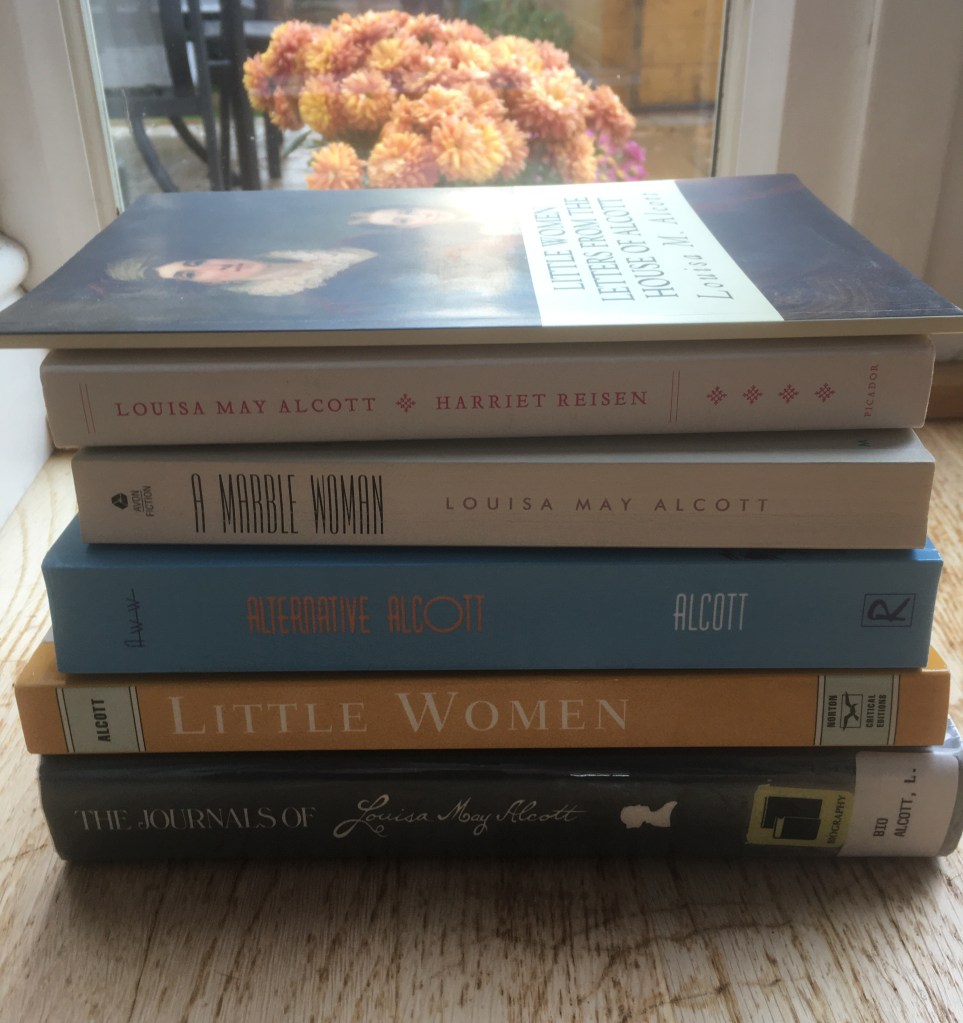
    These are some of the books I found helpful during my research.
  • Elizabeth Gaskell and ‘Wives and Daughters’

    Elizabeth Gaskell died in 1865 leaving behind a wide range of works – novels, novellas, short stories, poetry and non-fiction.  Her final novel, Wives and Daughters lay unfinished, just shy of the final chapter or so.  There is some common ground here between Elizabeth Gaskell and the later writer Edith Wharton, who died before the completing the final chapters of The Buccaneers (1938).  Both writers had their incomplete novels published posthumously.  Both writers decided to set their final works in an earlier time.  Edith Wharton, writing in the 1930s, decided to return to the 1870s in The Buccaneers.  Elizabeth Gaskell, writing in the 1860s, returned to the 1820s in Wives and Daughters.  It is interesting, that at this stage of their lives, both writers decided to revisit a bygone age.

    In some ways it is difficult to know where to start with Wives and Daughters.  It is a large, and in some ways, a complex novel spanning some 580 plus pages.  At the heart of the novel is the story of young Molly Gibson and her journey from childhood into maturity and the relationships she forms with those around her.  However, in many ways, this is an oversimplification of a very rich text.  Gaskell explores some complex issues and the novel contains many carefully drawn characters.  It features not only birth, marriage and death, but secrets and lies, conflict and humour, and is much more than a simple tale of Molly’s maturation.  It opens in a fairytale like manner:

    To begin with the old rigmarole of childhood. In a country there was a shire, and in that shire there was a town, and in that town there was a house, and in that house there was a room, and in that room there was a bed, and in that bed there lay a little girl; wide awake and longing to get up, but not daring to do so for fear of the unseen power in the next room…

    The ‘unseen power’ is Betty the maid, and the little girl is the aforementioned Molly.  The ‘sing-song’ rhythmic nature and the use of repetition is a little like a nursery rhyme, but it also achieves an image which moves from a wide view to a specific focus. Whether you find this opening endearing or a little off-putting, please forge ahead as you will not be disappointed.

    …To read the rest of the article (free) please follow the link to Wordsworth Editions click here

    Leave a comment

    Leave a comment

  • A Princess in the Attic

    Here is another piece originally written for Wordsworth Editions Blog.

    I first came across A Little Princess through the 1973 BBC adaptation and was immediately captivated by it. I am not sure exactly what drew me in but having recently returned to the original novel I realise I was a similar age to the gently heroic Sara Crewe when the narrative begins. Frances Hodgson Burnett’s tale of the experiences of young Sara, born in India and who at the tender age of seven arrives at Miss Minchin’s Select Seminary for Young Ladies in London, has remained in print since its first publication in 1905.

    Just to clarify, Sara is not actually a princess, although at the start of the narrative she is extremely privileged, wealthy and much loved by her father Captain Crewe.  She arrives at school with an elaborate wardrobe with ‘sable and ermine on her coats, and real Valenciennes lace on her underclothing’ (Chapter 1).  Her favourite doll Emily also has an extensive wardrobe and Sara’s status is such that she has her own private sitting-room and a French maid. The very strict Miss Minchin finds her clothing ‘perfectly ridiculous’ for a child of her age, but is more than happy to exploit the benefits of having such a wealthy pupil at her school.

    The narrative is a relatively simple one and on the surface this may seem like an ordinary school novel, in that Sara has to overcome her initial homesickness at leaving her beloved father, and cope with a headmistress who does not like her. There are the challenges of making friends as she is unable to win the approval of the clique of popular girls led by the nasty Lavinia. Despite these challenges, Sara settles in and all is well until her eleventh birthday at which point tragedy strikes when Miss Minchin receives news of Captain Crewe’s death.  This is where matters take a decided turn for the worst as Captain Crewe has lost his fortune through a disastrous investment in a diamond mine. Sara is left a penniless and homeless orphan at the mercy of Miss Minchin. Rather than turn her out onto the street, Miss Minchin is persuaded to consider her reputation and instead puts Sara to work and banishes her to a cold attic, minus her extensive wardrobe.  The rest of the narrative follows Sara’s efforts to survive her harsh living conditions and her attempts to make the best of her situation by relying on her very active imagination. However, if you peel away the top layer of an apparently simple children’s story, it becomes apparent Frances Hodgson Burnett has something to say about child poverty in Edwardian Britain.

    The novel went through a number of incarnations, beginning as a serialized short story in 1887, before becoming a successful stage play during the 1890s. In 1905 it was expanded into the novel we now have.  It’s original title was A Little Princess: Being the Whole Story of Sara Crewe Now Being Told for the First Time. This included an introduction written by Burnett in which she said ‘… between the lines of every story there is another story…’ Burnett’s reasons for expanding and developing the story were, in part, financially motivated. Following her divorce from Swan Burnett and then a second divorce after a disastrous short marriage to Stephen Townsend, a man somewhat her junior, Burnett found herself in need of some additional income. This was solved by transforming the stage version of A Little Princess into a novel.

    … To read the full article, please head over to Wordsworth Editions. Click here…

    Leave a comment