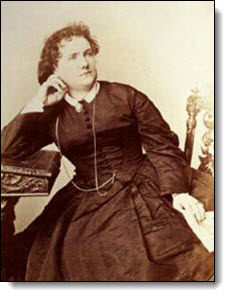
I have read a number of books by Mary Elizabeth Braddon, and this one I enjoyed more than some of the others. For a writer of sensation novels who produced more than eighty books, only one of her works seems to get most of the attention, and that is Lady Audley’s Secret. It is indeed a fine text, and a prime example of everything which made the sensation novel such a success in the mid-Victorian period, but it is a pity most of her other works tend to be overlooked.
Like many of her works, Henry Dunbar first appeared in serialized form under the title The Outcasts. Installments in the London Journal began in September 1863 and concluded in March 1864. Braddon’s ‘husband’ and agent John Maxwell was unhappy with the sum offered by Tinsleys, publishers of her previous novels and as they refused to increase their fee, this became the first of Braddon’s novels to be published by Maxwell. If you are wondering why the marital status is in inverted commas, this is because they were not actually married. They were living together as husband and wife, but Maxwell’s actual wife was still alive and living in Ireland. I have written about this in my previous blog post on ‘Eveline’s Visitant’
The tale begins with the young Henry Dunbar and Joseph Wilmot employed in a London Banking House. Dunbar manages to run up large gambling debts and convinces his friend Wilmot, who happens to have a talent for ‘copying’ handwriting, to create some forged bonds in order to pay off his debtors, claiming Wilmot will be rewarded. However, the crime is discovered and Dunbar lays the blame squarely on the gullible Wilmot. The owner of the bank, Dunbar’s uncle, banishes him to their Indian office and fires Wilmot. Poor Joseph Wilmot is unable to find respectable work due to the scandal and falls into a life of crime, which ultimately results in him being transported to Tasmania. He blames Dunbar for his misfortunes, as does his daughter Margaret. Years pass and following his release, Wilmot and his daughter live under the assumed name of Wentworth. Henry Dunbar returns from exile to inherit the family business and become a very wealthy man. In true Braddon style, there is high drama and many twists and turns follow.
However, there is more to this text than just the usual melodrama, evidence by some of the criticism it received on publication. Jennifer Carnell, in her excellent work The Literary Lives of M.E. Braddon writes of how contemporary critics gave negative reviews and accused Braddon of glorifying criminals through her depictions of villains. I agree with Carnell who disputes this, suggesting Braddon does not sympathise with crime, but instead seeks to explain it. It is hopefully not too much of a spoiler, as this happens early in the novel, but Wilmot confronts Dunbar on his return to England, following which, Wilmot disappears. This makes way for a move into the realms of detective fiction as Margaret strives to ascertain what has happened to her father.
There are many qualities in Braddon’s writing, one of which is her ability to evoke a sense of place. After the initial dramatic reunion between the two men, they appear to reconcile, although it is apparent to the reader that the reconciliation is false on both sides. They dine at The Dolphin Hotel in Southampton, a place which still exists and has a long history as a famous coaching Inn. They travel to Winchester where Wilmot is to be the guest of Dunbar at The George, another famous coaching Inn which has since been demolished. Braddon writes of their sojourn:
They walked under the shadow of a low stone colonnade, and then turned aside by the market-place, and made their way into the precincts of the cathedral. There are quaint old courtyards, and shadowy quadrangles hereabouts; there are pleasant gardens, where the flowers seem to grow brighter in the sanctified shade than other flowers that flaunt in the unhallowed sunshine. (Chapter 8)
Not only does Braddon create a remarkable sense of place here, but I also cannot help but think she is making a symbolic point through her description of the flowers.
Real places continue to be evoked as the narrator refers to the two men strolling from the cathedral towards St Cross and the Water Meadows. They are due to dine together later, but Joseph Wilmot has disappeared, and his body is later discovered.
There are several detectives seeking the truth in this novel, both official and unofficial, and the dialogue Braddon creates during the Inquest reads like an early precursor to the genre of the courtroom drama. Scotland Yard become involved through the character of detective Mr Carter. Arthur Lovell, a young lawyer also joins the investigation and his pursuits are described in detail, but it is Margaret who is relentless in her search for the truth. Wilkie Collins, a contemporary of Braddon is much more well known and is often referred to as the father of the British detective novel through his work The Moonstone (1868). With Henry Dunbar appearing four years earlier, maybe Braddon could be thought of as the mother of the detective novel.
 Literary Likes
Leave a comment