Tag: Victorian fiction

  • Henry Dunbar by Mary Elizabeth Braddon

    I have read a number of books by Mary Elizabeth Braddon, and this one I enjoyed more than some of the others.  For a writer of sensation novels who produced more than eighty books, only one of her works seems to get most of the attention, and that is Lady Audley’s Secret.  It is indeed a fine text, and a prime example of everything which made the sensation novel such a success in the mid-Victorian period, but it is a pity most of her other works tend to be overlooked.

    Like many of her works, Henry Dunbar first appeared in serialized form under the title The Outcasts.  Installments in the London Journal began in September 1863 and concluded in March 1864. Braddon’s ‘husband’ and agent John Maxwell was unhappy with the sum offered by Tinsleys, publishers of her previous novels and as they refused to increase their fee, this became the first of Braddon’s novels to be published by Maxwell.  If you are wondering why the marital status is in inverted commas, this is because they were not actually married.  They were living together as husband and wife, but Maxwell’s actual wife was still alive and living in Ireland.  I have written about this in my previous blog post on ‘Eveline’s Visitant’

    The tale begins with the young Henry Dunbar and Joseph Wilmot employed in a London Banking House.  Dunbar manages to run up large gambling debts and convinces his friend Wilmot, who happens to have a talent for ‘copying’ handwriting, to create some forged bonds in order to pay off his debtors, claiming Wilmot will be rewarded.  However, the crime is discovered and Dunbar lays the blame squarely on the gullible Wilmot.  The owner of the bank, Dunbar’s uncle, banishes him to their Indian office and fires Wilmot.  Poor Joseph Wilmot is unable to find respectable work due to the scandal and falls into a life of crime, which ultimately results in him being transported to Tasmania.  He blames Dunbar for his misfortunes, as does his daughter Margaret.  Years pass and following his release, Wilmot and his daughter live under the assumed name of Wentworth.  Henry Dunbar returns from exile to inherit the family business and become a very wealthy man.  In true Braddon style, there is high drama and many twists and turns follow.

    However, there is more to this text than just the usual melodrama, evidence by some of the criticism it received on publication.  Jennifer Carnell, in her excellent work The Literary Lives of M.E. Braddon writes of how contemporary critics gave negative reviews and accused Braddon of glorifying criminals through her depictions of villains.  I agree with Carnell who disputes this, suggesting Braddon does not sympathise with crime, but instead seeks to explain it.  It is hopefully not too much of a spoiler, as this happens early in the novel, but Wilmot confronts Dunbar on his return to England, following which, Wilmot disappears.  This makes way for a move into the realms of detective fiction as Margaret strives to ascertain what has happened to her father.

    There are many qualities in Braddon’s writing, one of which is her ability to evoke a sense of place.  After the initial dramatic reunion between the two men, they appear to reconcile, although it is apparent to the reader that the reconciliation is false on both sides.  They dine at The Dolphin Hotel in Southampton, a place which still exists and has a long history as a famous coaching Inn.  They travel to Winchester where Wilmot is to be the guest of Dunbar at The George, another famous coaching Inn which has since been demolished.  Braddon writes of their sojourn:

    They walked under the shadow of a low stone colonnade, and then turned aside by the market-place, and made their way into the precincts of the cathedral.  There are quaint old courtyards, and shadowy quadrangles hereabouts; there are pleasant gardens, where the flowers seem to grow brighter in the sanctified shade than other flowers that flaunt in the unhallowed sunshine.  (Chapter 8)

    Not only does Braddon create a remarkable sense of place here, but I also cannot help but think she is making a symbolic point through her description of the flowers.

    Real places continue to be evoked as the narrator refers to the two men strolling from the cathedral towards St Cross and the Water Meadows.  They are due to dine together later, but Joseph Wilmot has disappeared, and his body is later discovered.

    There are several detectives seeking the truth in this novel, both official and unofficial, and the dialogue Braddon creates during the Inquest reads like an early precursor to the genre of the courtroom drama.  Scotland Yard become involved through the character of detective Mr Carter.  Arthur Lovell, a young lawyer also joins the investigation and his pursuits are described in detail, but it is Margaret who is relentless in her search for the truth.  Wilkie Collins, a contemporary of Braddon is much more well known and is often referred to as the father of the British detective novel through his work The Moonstone (1868).  With Henry Dunbar appearing four years earlier, maybe Braddon could be thought of as the mother of the detective novel.

  • The Classics Club Spin #44

    This will be my first time taking part in the Classics Club Spin. What is this? Well, you create a list which includes 20 titles from your main Classics Club Challenge list. On Sunday 17th May they will post a number from 1 to 20. The challenge is to read whatever book falls under that number by 5th July 2026. This is my list:

    • 1. Jane Austen, Persuasion
    • 2. Dorothy Bowers, Fear for Miss Betony
    • 3. Mary Elizabeth Braddon, Henry Dunbar
    • 4. Christianna Brand, Green for Danger
    • 5. L. M. Montgomery, Anne of Windy Poplars
    • 6. Frances Hodgson Burnett, The Making of a Marchioness
    • 7. Anne Bronte, The Tenant of Wildfell Hall
    • 8. Sir Arthur Conan Doyle, His Last Bow
    • 9. John Galsworth, The Man of Property
    • 10. Elizabeth Gaskell, Ruth
    • 11. Anna Katherine Green, The Circular Study
    • 12. Henry James, The Turn of the Screw
    • 13. E.C.R. Lorac, Fell Murder
    • 14. Gladys Mitchell, Laurels are Poison
    • 15. Edith Nesbit, The Lark
    • 16. May Sinclair, Mary Olivier: A Life
    • 17. Josephine Tey, The Francise Affair
    • 18. Anthony Trollope, Barchester Towers
    • 19. Patricia Wentworth, Ladies Bane
    • 10. Mary Westmacott, Absent in the Spring

  • Louisa Alcott and the American Civil War

    This is the second half of the lecture began in an earlier post. In this post I focus on Louisa Alcott’s time working as a nurse during the Civil War and some of her later writings inspired by her experiences.

    In some ways, the Civil War functioned as a liberating experience for Louisa.  By this point in her life, she had endured some difficult years.  She had lived through the death of one sister and the marriage of another.  Her hopes for education and independence were unrealised, partly due to the conventions of 19th Century life for women and partly due to years of family poverty.

    Her family were politically active as strong supporters of the Abolitionist movement and at one point, they harboured a fugitive slave.  Although she often thought of herself as ‘the family’s son’ she remained frustrated that her gender limited her ability to be involved in political activism.  On the outbreak of war, her journal entry read:

    I’ve often longed to see a war, now I have my wish.  (12 April 1861)

    By November 1862, she was almost thirty years old, and her diary revealed the formation of her plans:

    Decided to go to Washington as a nurse if I could find a place.  I love nursing and must let out my pent up energy in some way.  I set forth… feeling as if I was the sone of the house going to war.

    Nursing offered a respectable way for women to become involved in the war effort.  A lady by the name of Dorothea Dix, the superintendent of Union Army Nurses issued a call for volunteers stating they should be married and “past 30 years of age, healthy, plain almost to repulsion in dress and devoid of personal attractions.”  The rule regarding marriage was relaxed following an influx of casualties from the Battle of Bull Run in the summer of 1862.

    On 11 December 1862 Louisa received her orders to leave the following day for Washington Union Hospital, Georgetown.  The journey was an arduous one of 500 miles and included a train to New London, Connecticut, a steamship from Boston to New Jersey, and finally a train to Washington DC.  She wrote of passing the brightly lit White House and the unfinished dome of the Capitol Building.

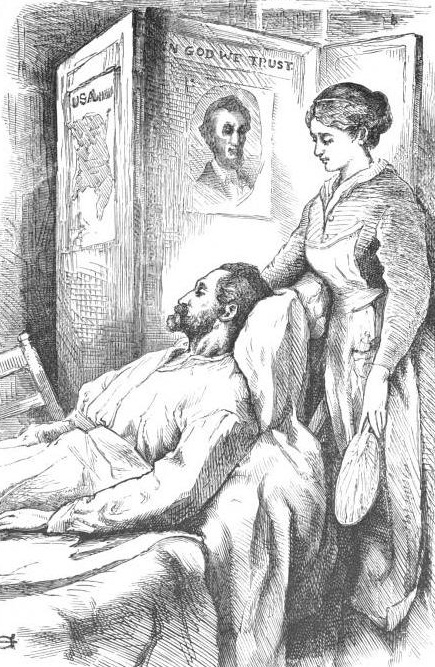
    The Union Hospital was a hastily converted hotel.  Her journals reveal it was badly lit, crowded and poorly ventilated as some of the windows were nailed shut.  Others has smashed panes covered by curtains to keep out drafts. On arrival, she was put in charge of forty soldiers who were suffering from rheumatic fever.  After only three days, there was a influx of wounded soldiers from Fredricksburg.  She was give block of brown soap and a washbasin and told to wash them as fast as she could, which she proceeded to do for the next twelve hours.  By the next day, she was required to assist with amputations.  As you can see, there was no training to ease nurses into their duties.

    One of her responsibilities was to assign patients to the appropriate areas in the three room ward.  This was organised as:

    • Duty room – recently wounded soldiers
    • Pleasure room – recovering soldiers
    • Pathetic room – soldiers with little or no chance of recovery.

    Christmas and New Year came and went, and her diary entry for 1 January 1863 reveals she was rising to the challenge:

    Five hundred miles from home, alone among strangers, doing painful duties all day long, and leading a life of constant excitement in this great house surrounded by 3 or 4 hundred men in all stages of suffering, disease and death.  Though often homesick, heartsick and worn out, I like it.

    However, her career as a nurse was not destined to be a long one.  After weeks of nonstop work, poor food, stale air and exposure to infection, she ended up with typhoid pneumonia.  She tried to ignore her symptoms until one of the doctors ordered bed rest.  Her diary entry reveals her suffering and a sense of fear:

    Sharp pain in the side, cough, fever and dizziness.  A pleasant prospect for a lonely soul five hundred miles from home… Dream awfully, and awake unrefreshed, think of home and wonder if I am to die here as Mrs Ropes is likely to do.

    Mrs Ropes was the matron of the hospital and had also contracted typhoid pneumonia.  She was concerned about Louisa’s worsening state and had written to Bronson advising him to collect his daughter.  On 20th January, Mrs Ropes died and Louisa agreed to return home.  She had only served six weeks of her three month placement. The illness was lengthy.  Following the journey home with her father it was eight weeks before she was able to sit up in bed.  She had been feverish and suffering delusions for three weeks.  Her hair was cut short, something which was common practice as an attempt to combat illness in the Nineteenth Century.  She was finally able to leave her room in the spring, and wrote in her journal “I was never ill before this time, and never well afterward.”  This refers to ongoing bouts of ill health which she began to experience a few years later.  She had been given Calomel, a mercury compound, which was a popular remedy for many illnesses.  For many years it was thought her health condition resulted from mercury poisoning, however, recent thinking disputes this and the theory now, is she may have developed Lupus.

    Her letters home and journal entries were the inspiration behind what would become the novella Hospital Sketches.  The material was first published as a series of letters in two instalments in The Boston Commonwealth, a known anti-slavery paper.  The first instalment came out in May 1863, with the second instalment being eagerly awaited.  The reading public were eager for knowledge of the war and little was known about life in the hospitals.  In October it was published in book form under the title Hospital Sketches and Camp Fireside Stories and included eight additional short stories. The character starts out as “Topsy Turvy Trib” and is deliberately mocking of her own self importance and dedication.  Alcott added a postscript to the novel defending:

    the tone and levity in some portions of the sketches… It is a part of my religion to look well after the cheerfulness of life, and let the dismals shift for themselves.

    The novel begins with Trib wanting to do something productive with her life but observing the only options open to her were matrimony, teaching, writing, acting or nursing.  Of these, the least reputable would have been to become an actress.  Employment was clearly an issue which concerned Alcott, and were explored again in a later novel entitled Work: A Story of Experience (1873).

    Hospital Sketches begins prior to Trib’s journey to the hospital, which is re-named “Hurly-burly House”.  Alcott’s frustrations at the bureaucracy she encountered form part of the early stages of Trib’s journey.  Once in post, she is immediately put to work:

    … with pneumonia on one side, diptheria on the other, five typhoids on the opposite, and a dozen dilapidated patriots, hopping, lying, and lounging about.

    With each passing day, Trib becomes more deeply drawn into the effects of the war and moves from the persona of comic spinster to serious witness.  The reader follows Trib’s movement from innocence to maturity.  She becomes disillusioned by her experiences and shocked at the differences between the fabled and real war.  The pithy tone of Alcott’s writing makes clear her outrage at examples of mis-management of the hospital, including the nailing shut of the windows.  She describes the callous and indifferent attitudes of the surgeons, contrasted against the matron who would happily give up her food rations for the patients.  She also criticises the hospital chaplain for the lack of comfort offered to dying men.

    The novella is a curious text in that it blends the horrors of hospital life with a light hearted tone as we follow the exploits of protagonist Tribulation Periwinkle.  When I taught this book a few years ago, my students observed the writing style felt quite modern.  Indeed, the colloquial tone of the book serves to mediate some the unpleasant detail of the hospital ward.  She was paid $200 for Hospital Sketches, and it was this publication which set her on the road to becoming taken seriously as Louisa Alcott, the writer.

  • Louisa Alcott’s Blood and Thunder Tales

    Some years ago I gave a lecture to a local literary society, which I then repeated for the WEA.  The subject was Louisa Alcott’s work outside of Little Women and we explored her love of writing gothic stories, as well as her experiences as a nurse during the American Civil War.  Below is the first half of the lecture which introduces her gothic writing, which she referred to as her ‘blood and thunder tales.’

    Let’s start with a well known beginning:

    “Christmas won’t be Christmas without any presents” grumbled Jo, lying on the rug.

    “Its so dreadful to be poor!” sighed Meg, looking down at her old dress.

    “I don’t think it’s fair for some girls to have plenty of pretty things, and other girls nothing at all,” added little Amy, with an injured sniff. “We’ve got Father and Mother, and each other” said Beth contentedly from her corner.

    You may well recognizable this as the beginning to Little Women, a novel which has not been out of print since its initial publication in 1868.  As well as being a memorable beginning, it is effective in establishing the character types of the four main players:

    • Jo as the focaliser, her personality already coming through as lying on the rug would not have been ladylike behavior in the 19th Century.
    • Meg, the eldest sister, often concerned with her appearance (and frequently frustrated by Jo’s)
    • Petulant Amy, the youngest of the four.
    • And the somewhat saintly and home-loving Beth.

    The Little Women series of novels is the work Louisa Alcott is most remembered for, yet Little Women is the novel she least wanted to write, declaring she didn’t know how to write for girls.  When Little Women was published in 1868, she was more well known for writing lurid gothic thrillers and as the author of Hospital Sketches, a fictionalized account of her experiences as a nurse in the American Civil War.

    Like the eponymous Jo March, Louisa was the second of four sisters, lived most of her life in poverty, and often worked to support her family.  The form of her employment varied from writing, to teaching, to sewing, to working as a companion to wealthier friends and relatives, from which she secured an expenses paid trip to Europe.  The family’s lack of financial stability resulted from the unconventional lifestyle of her parents Amos Bronson and Abba May Alcott.

    Her writing output was prolific – at least 270 works ranging from poetry to novels to essays.  These included 9 novels and 16 short story collections which would now be placed in the genre of young adult fiction; 4 adult novels – Moods (1864), Work (1873), A Modern Mephistopheles (1877), and Diana and Persis (1879).  In addition, she wrote lots of melodramatic gothic works under the gender neutral name A.M. Barnard.

    She called her thrillers her ‘Blood and Thunder tales’.  Themes such as secret family curses, murder, revenge, domineering men, manipulative women, drugs and incest featured in these tales.  These appeared in popular magazines, some were short stories, others were novellas, and most of them were written under her pseudonym A.M. Barnard.

    For many years these works were lost until they were discovered in the Harvard library by scholar Madeleine Stern and rare book collector Leona Rostenberg.  In 1943 on a research visit to the library they realised Louisa Alcott and A.M. Barnard were one and the same.  Their excitement was immense at having discovered these works.  They were not allowed to remove them from the library, instead they had to painstakingly copy all of these works by hand.  Although the discovery was made in 1943, it was not until the 1970s that some of these lost works were re-published.

    One of her longer thrillers – A Modern Mephistopheles, was published anonymously in 1877, after the success of Little Women.  This featured the character Jasper Helwyze who gives hashish to the heroine.  However, most of her thrillers were written before her fame as a way of providing financial support to the family.  These bore titles such as ‘Norna; or The Witch’s Curse’, ‘The Captive of Castile’, ‘The Moorish Maiden’s Vow’, ‘Pauline’s Passion and Punishment’, ‘The Mysterious Key and What It Opened’ and ‘The Abbott’s Ghost or Maurice Treherne’s Temptation.’

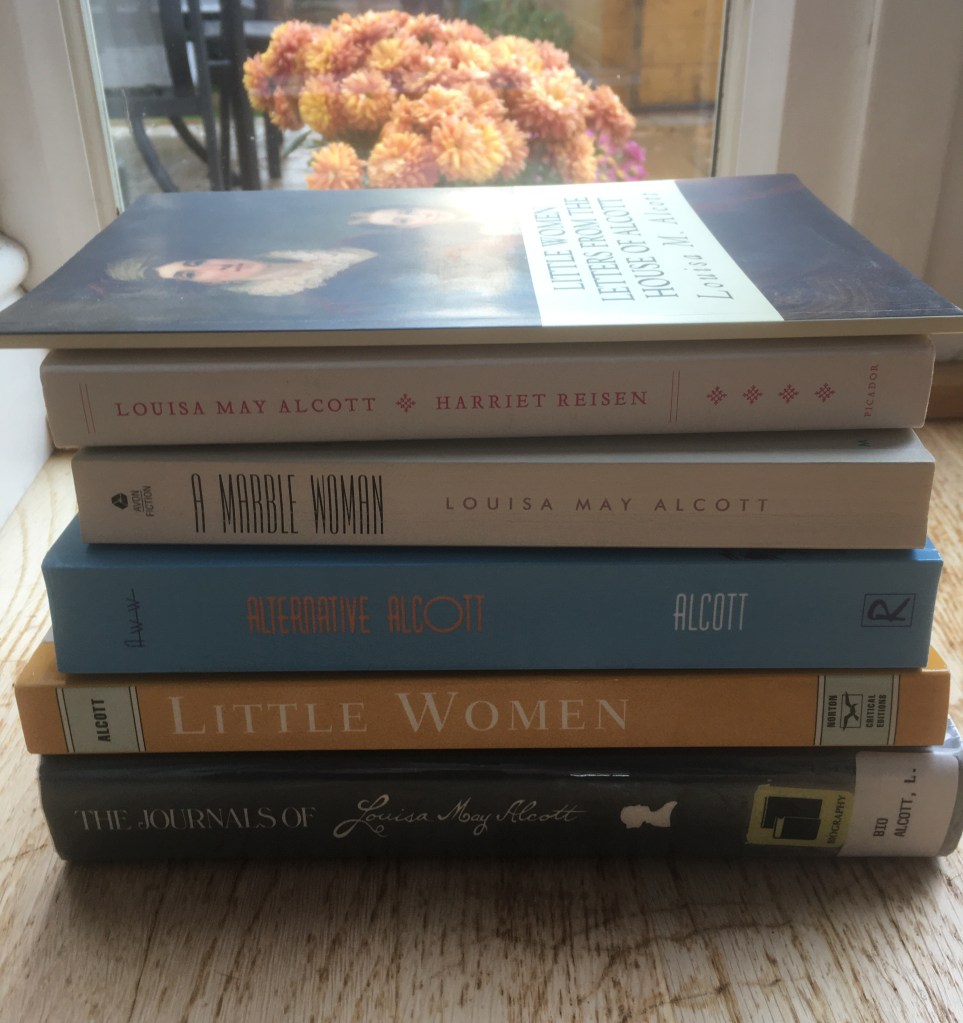
    Rather like Jo March in her garret, Louisa wrote stories such as ‘The Rival Prima Donnas’ where a singer takes vengeance by crushing her competitor to death with an iron ring.    Since Louisa’s stories were rediscovered, a number have been collected and republished.  ‘A Marble Woman’ is an eerie tale of domineering males, submissive women, opium addiction and possible incest. Drugs also feature in her work ‘Perilous Play’ where a group of young adults at a picnic experiment with hashish laced candies, almost ending in disaster.

    ‘The Abbot’s Ghost: or Maurice Treherne’s Temptation’ is set in a haunted English abbey and has quite a Dickensian feel to it.  The cast of characters sit around a hall fire telling ghost stories about haunted houses, coffins and skeletons.  Edith Snowden is Louisa’s strong willed woman with a mysterious past in this tale. ‘A Whisper in the Dark’ was a mystery story about Italian refugees, a spy, and a woman disguised as a man.

    ‘Pauline’s Passion and Punishment’ is another tale of vengeance with the manipulative protagonist Pauline enacting punishment on her fiancé Gilbert Redmond who breaks off their engagement in order to marry a much wealthier woman. Like many of Alcott’s female characters, Pauline is socially disadvantaged. Although born to a wealthy family, she is reduced to working as a governess.  The plot is highly melodramatic as Pauline enacts a plan to marry a younger man as well as making her former fiancé fall in love with again, simply so she can reject him.  The young sensitive Manuel has fallen in love with her and offers to kill Gilbert, however, she refuses, proclaiming:

    “There are fates more terrible than death, weapons more keen than poniards, more noiseless than pistols… Women use such, and work out a subtler vengeance than men can conceive. Leave Gilbert to remorse and me.”

    She does, however, persuade Manuel to marry her as she needs money in order to finance her revenge. She does not deceive Manuel regarding her motivations though and explains:

    “I want fortune, rank, splendor, and power; you can give me all these… I desire to show Gilbert the creature he deserted no longer poor, unknown, unloved, but lifted higher than himself, cherished, honored, applauded, her life one royal pleasure, herself a happy queen”

    The story is full of suspense which builds during the search for Gilbert and his new bride but I don’t wish to spoil the ending.  The story won a $100 dollar prize in a writing contest which helped with Louisa’s expenses in taking up her post as a Civil War nurse in Washington DC.

    Although Louisa did not publicly acknowledge her blood and thunder stories, and distanced herself through the use of her pen name, letters and journal entries indicate she enjoyed writing them:

    “I think my natural ambition is for the lurid style.  I indulge in gorgeous fancies and wish that I dared inscribe them upon my pages and set them before the public.”

    The main publishers of Louisa’s Blood and Thunder tales were The Flag of our Union as well as Frank Leslie’s Illustrated Newspaper.  In Little Women these become the Blarneystone Banner and Weekly Volcano.  One of her letters stated:

    “I intend to illuminate The Ledger with a blood & thunder tales as they are easy to ‘compoze’ & are better paid than moral works.”

    Indeed, each story earned her between $50-75, which is roughly the equivalent of $2000 – $3000 today. Although the characteristics of these works clearly placed them within the gothic genre, her works are differentiated by her concern with character development.  Gone were the trembling, submissive heroines usually associated with 18th and 19th Century Gothic.  Her works are well worth a read if you like gothic fiction with a more active heroine.  Alcott’s women were strong, even if many of them were evil.

    These are some of the books I found helpful during my research.
  • Man-Size in Marble: A Tale for Halloween

    Halloween is the perfect time for reading ghostly tales. This offering from Edith Nesbit is set at that spooky time of year. Here is an excerpt of my article on her short story ‘Man-Size in Marble’. The full article can be found by following the link to the Wordsworth blog.

    Halloween season, in common with Christmas, is the time of year many an avid reader will reach for a ghostly tale. Whilst sitting comfortably by the fireside hopefully the story will provide just the right amount of gentle chill to the room and a soft breeze to the back of the neck. If this description appeals, ‘Man-Size in Marble’ maybe just the tale you are looking for.

    This story fits the bill in a number of ways, it is set in the period leading up to Halloween, with the climax occurring on that fateful night. The tale is told by a male narrator who immediately alerts the reader that this will not be a happy tale. The opening line sets up an air of mystery: ‘Although every word of this tale is true, I do not expect people to believe it.’ He goes on to reveal: ‘There were three who took part in this; Laura and I and another man. The other man lives still, and can speak to the truth of the least credible part of my story.’ There are indeed some troubling implications established in the first paragraph, however, before exploring the story further, a little background is in order.

    ‘Man-Size in Marble’ was first published in Home Chimes magazine in December 1887 and came from the pen of Edith Nesbit. If that name seems familiar, it is not surprising, as she would later become famous for her highly popular novel The Railway Children (1905) and other children’s fiction including Five Children and It (1902) and The Enchanted Castle (1907). However, in addition to her successful children’s fiction, Nesbit wrote a number of chilling ghost stories for adults, in addition to poetry and other works in collaboration.

    To say Edith Nesbit led a Bohemian life would be somewhat of an understatement. When she married her husband Hubert Bland, she was already seven months pregnant. During their marriage, Bland fathered two children by Nesbit’s friend Alice Hoatson, and Nesbit raised them as her own. Both Nesbit and Bland had affairs and their home in Eltham was lively place with frequent visitors, including such well known names as H.G. Wells.

    Nesbit and her husband were politically active and were the co-founders of the Fabian Society, to which the roots of the Labour party can be attributed. Nesbit and Bland also wrote fiction together under the pseudonym Fabian Bland. If you look carefully, some of her socialist beliefs are apparent in her children’s fiction. Although a politically active woman writer, her attitudes towards the Women’s Suffrage Movement was at best ambivalent and at times directly opposed. Some of Nesbit’s attitudes and beliefs appear to have worked their way into her gothic stories too, along with her lifelong fascination for ghosts.

    To read my discussion of ‘Man-Size in Marble’ please follow the link click here


  • Back to School with Anne of Avonlea

    ‘Oh, will I ever learn to stop and reflect a little before doing reckless things? Mrs Lynde always told me I would do something dreadful someday, and now I’ve done it.’

    Fans of the eponymous orphan Anne Shirley will have probably first encountered her in L.M. Montgomery’s novel Anne of Green Gables, published in 1908. The publishers must have had faith in its potential as Lucy Maud Montgomery was tasked with writing a sequel before the print run of her first novel was completed. Thus, Anne of Avonlea arrived on the shelves in 1909 to great success.

    Anne of Green Gables follows young Anne Shirley from her first arrival at the Cuthbert’s farm brought about by a mistake made by the orphanage where she was formerly residing. Siblings Matthew and Marilla Cuthbert had requested to adopt a boy to help them with the farm work. They are soon both foiled in their intentions to return Anne in favour of the sought after boy, as they become increasingly captivated by the imaginative, talkative young redhead with a fiery temper to match her hair. The novel documents Anne’s exploits and development and at the conclusion she is sixteen years old and has already had to make some difficult decisions. Despite her keen intelligence and potential Anne decides to forego college and remain at home to support an ailing Marilla.

    Anne of Avonlea picks up almost where Anne of Green Gables left off and the narrator informs us ‘Anne is half-past sixteen’ and about to take up her first teaching post at the local school. The novel covers a two year period in Anne’s life, and rather than presenting a sustained linear narrative, the reader is offered a series of incidents and vignettes. Characters from the earlier novel return, along with some well developed new additions. This format provides Maud (as she preferred to be known) with an ideal format in which to not only follow Anne’s growing maturity, but also to address some proto-feminist concerns such as women’s education and marriage. Any evidence of feminism in the text is of the gentle variety though. Anne and her friends form the Avonlea Village Improvement Society of which Anne and her best friend Diana Barry are Secretary and Treasurer whereas the more senior roles of President and Vice President are held by Gilbert Blythe and Fred White. Thus, in this instance, traditional gender roles are maintained.

    Anne’s assertiveness and independence of spirit are evident throughout though. During an angry encounter with their new neighbour Mr Harrison, he calls her a ‘red-headed snippet’. Anne’s customary temper flares and drives her cutting response ‘I’d rather have red hair than none at all except a little fringe around my ears.’ Anne’s tendency to get into scrapes is still present despite being half-past sixteen. An early example is where she accidentally sells the aforementioned Mr Harrison’s cow, believing it to be her own. Despite this incident, Anne’s courage in owning up to her guilt ensures she wins over the cranky Mr Harrison and ultimately they become firm friends.

    … To read the rest of this article, please follow the link to Wordsworth Editions

    <<click here>>

    Leave a comment


  • Elizabeth Gaskell and ‘Wives and Daughters’

    Elizabeth Gaskell died in 1865 leaving behind a wide range of works – novels, novellas, short stories, poetry and non-fiction.  Her final novel, Wives and Daughters lay unfinished, just shy of the final chapter or so.  There is some common ground here between Elizabeth Gaskell and the later writer Edith Wharton, who died before the completing the final chapters of The Buccaneers (1938).  Both writers had their incomplete novels published posthumously.  Both writers decided to set their final works in an earlier time.  Edith Wharton, writing in the 1930s, decided to return to the 1870s in The Buccaneers.  Elizabeth Gaskell, writing in the 1860s, returned to the 1820s in Wives and Daughters.  It is interesting, that at this stage of their lives, both writers decided to revisit a bygone age.

    In some ways it is difficult to know where to start with Wives and Daughters.  It is a large, and in some ways, a complex novel spanning some 580 plus pages.  At the heart of the novel is the story of young Molly Gibson and her journey from childhood into maturity and the relationships she forms with those around her.  However, in many ways, this is an oversimplification of a very rich text.  Gaskell explores some complex issues and the novel contains many carefully drawn characters.  It features not only birth, marriage and death, but secrets and lies, conflict and humour, and is much more than a simple tale of Molly’s maturation.  It opens in a fairytale like manner:

    To begin with the old rigmarole of childhood. In a country there was a shire, and in that shire there was a town, and in that town there was a house, and in that house there was a room, and in that room there was a bed, and in that bed there lay a little girl; wide awake and longing to get up, but not daring to do so for fear of the unseen power in the next room…

    The ‘unseen power’ is Betty the maid, and the little girl is the aforementioned Molly.  The ‘sing-song’ rhythmic nature and the use of repetition is a little like a nursery rhyme, but it also achieves an image which moves from a wide view to a specific focus. Whether you find this opening endearing or a little off-putting, please forge ahead as you will not be disappointed.

    …To read the rest of the article (free) please follow the link to Wordsworth Editions click here

    Leave a comment

    Leave a comment

  • The Shadowy World of Edith Nesbit

    Recently, I was fortunate to have a very small involvement with some bibliography research regarding the newly published Wordsworth collection of Edith Nesbit’s ghost stories. I also wrote a blog discussing some of her ghostly tales which you can read an excerpt of below. If you would like to read the full article, just follow the link in the usual way.

    Chances are, many readers know Edith Nesbit from her creation of courageous Bobbie in the successfully adapted 1905 novel The Railway Children.  Or, possibly your first introduction was through the mysterious creature the Psammead in Five Children and It (1902), or perhaps the adventures of Jerry, Jimmy and Kathleen in The Enchanted Castle (1907).  Therefore, some may be surprised to find images such as the following, flowing from the same pen:

    … So he went upstairs, and at the door of the first bedroom he came to he struck a wax match, as he had done in the sitting rooms.  Even as he did so, he felt that he was not alone.  And he was prepared to see something but for what he saw he was not prepared.  For what he saw lay on the bed, in a white loose gown – and it was his sweetheart, and its throat was cut from ear to ear.

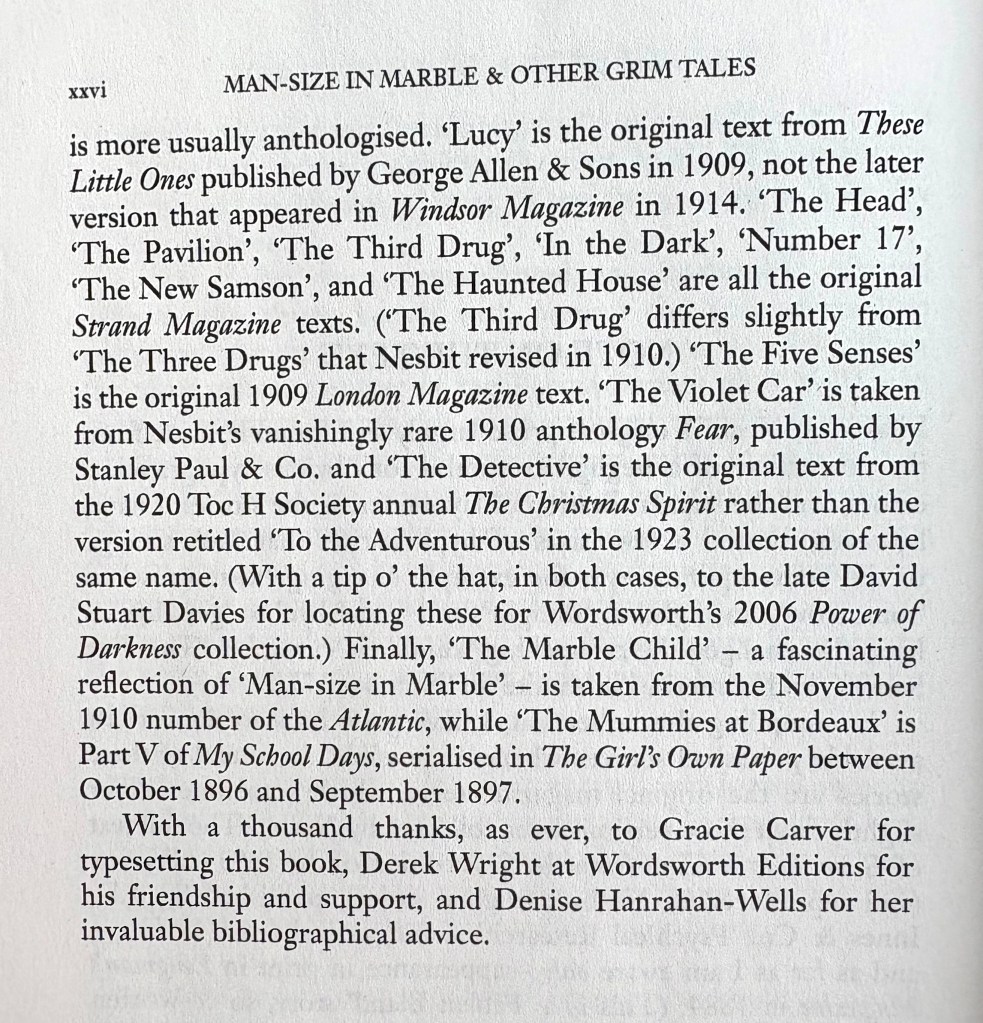
    This excerpt comes from Nesbit’s short story ‘The Mystery of the Semi-Detached’ included in her 1893 collection Grim Tales.  In just a few lines she moves from creating a vague sense of unease to a startling shock.  To say this is characteristic of Nesbit’s gothic writing is an oversimplification as she wrote many and varied short stories which could be categorized under the umbrella of horror.  Whilst there are distinct similarities regarding some aspects of style and thematics across her tales, there is also a rich variety and this sense of variety is exemplified by the newly published Wordsworth Edition Man-size in Marble and Other Grim Tales.

    Nesbit is not alone in being better known for other forms of writing, despite producing a significant amount of material in the horror genre.  Writers such as Charles Dickens, Elizabeth Gaskell, Edith Wharton, Henry James and E.F. Benson all had notable forays into the realms of gothic despite being more usually associated with other forms of writing.  Yet Nesbit wrote a large number of horror stories during the course of her writing career, although it is sometimes wrongly assumed this was simply something she did until her children’s stories made her famous.  Her horror works span from the late Victorian era of the 1880s up until the post First World War period, with her final story ‘The Detective’ appearing in 1920.

    Many of her stories made their first appearance in popular journals of the day such as Longman’s Magazine, Temple Bar, Windsor, and London Magazine.  The Strand Magazine, famous for its longstanding publication of Sir Arthur Conan Doyle’s Sherlock Holmes stories, also published many of Nesbit’s tales.  She collected some of her short stories together in several volumes, beginning with the previously mentioned Grim Tales and Something Wrong in 1893.  The Wordsworth Edition of her tales is unusual as it not only reproduces the Grim Tales collection in its entirety, but also includes all of her other horror stories, many of which have previously been overlooked.

    Stephen Carver’s Introduction to the collection discusses how biographies and other secondary writings about Nesbit’s work tend to focus on her children’s fiction, whilst her horror stories tend to be dismissed.  The Radio 4 programme Great Lives devoted an episode to Edith Nesbit on 22 April 2024.  She was chosen by children’s writer Katherine Rundell who praised her for continuing to inspire children’s fiction today.  Biographer Elisabeth Galvin joined the discussion and posited that Edith began writing through necessity as a young mother in order to help support the family.  At that time her husband Hubert Bland was very ill, almost dying from smallpox.  To compound matters his business collapsed when his partner absconded to Spain with all of their money.  Thus, she would sit up late into the night writing what Galvin described as ‘her hack stories for newspapers.’  Galvin is not alone in viewing Nesbit’s gothic work in this way and it is difficult to ignore the negative connotations imbedded in such a term.  The word ‘hack’ originates from Hackney Carriage, a form of transport available for hire.  Thus a ‘writer for hire’, namely someone who produces large amounts of writing quickly to earn money, may well be viewed in negative terms.  Similarly, genre fiction, for example horror and science fiction may also be dismissed as being popular, not highbrow or literary and thus unlikely to be art or to put forward important ideas.  Clearly, this is a rather traditional, and some may say outdated stance, but may well explain why Nesbit’s horror stories have attracted little critical attention.  A few of her stories have been anthologised over the years, most commonly ‘Man-size in Marble’ as well as ‘John Charrington’s Wedding’ and ‘The Ebony Frame’.

    Elisabeth Galvin’s biography of Nesbit does make mention of her horror stories, and unusually finds value in them, a position with which I agree.  Galvin suggests they originate from the mind of someone who was unhappy, and if you follow the details of her life, this may well seem true.  However, she states Nesbit should be ‘applauded for her pioneering ghost stories that were several degrees chillier than anything that had been written before.’  Nesbit does indeed develop a considerable amount of chill in her stories.  Whilst there are some similarities and recurring images, there are distinct differences too.  Sometimes there is a logical explanation for what initially appeared to be supernatural, other times the horror is unapologetically supernatural in origin.  Unusually for a lady writer of the time, many of her narrators are male, and not all of them are heroic.  The Wordsworth collection nicely exemplifies the range of her horror writing.  A few of the stories are quite humorous and playful, offering a little light relief from the darkly gothic tales, not all of which have happy endings.  Other stories defy expectations such as ‘The Haunted House’ first published in The Strand Magazine in 1913.  As its name suggests, this starts out as a haunted house tale, whereby the male protagonist answers an advertisement to investigate strange phenomena and arrives ‘in front of a white house with bare, gaunt windows.’  However, this is a story which shifts the ground beneath the reader as the narrative progresses.  How?  Well, you will need to read it to find out.

    To read the rest of this article, please follow the link to Wordsworth Editions Click here

    Leave a comment

  • Sherlock Holmes in 1924

    This is from my Wordsworth Blog written last year to commemorate three Sherlock Holmes stories written in 1924. Sherlock Holmes is one of my favourites and I am sure to write more on his antics in the future.

    Sherlock Holmes fiction probably conjures up images of fog bound London streets, hansom cabs and cosy scenes in 221b Baker Street with its Victorian décor.  However, this year marks the centenary of the publication of three particular Sherlock Holmes short stories and it may seem strange to think of Sherlock Holmes in the 1920s.  ‘The Adventure of the Sussex Vampire’ was first published in The Strand Magazine in January 1924.  This was followed by ‘The Adventure of the Three Garridebs’ in the American magazine Colliers in October 1924, later appearing in The Strand Magazine in January 1925.  Colliers also featured ‘The Adventure of the Illustrious Client’ in November 1924 and once again The Strand Magazine followed in suit in February – March 1925.

    It seems to be taken as a given by Holmes aficionados that the quality of Conan Doyle’s earlier Holmes stories far outweigh those produced later in his life.  The final collection of stories The Casebook of Sherlock Holmes, which includes the three aforementioned stories, does indeed contain some of the weaker tales in terms of plotting and solution.  This collection is discussed by the late David Stuart Davies in his Wordsworth blog of 5 June 2020, and as he suggests, many of the stories have a somewhat darker edge.

    I thought it might be interesting to cast a tighter focus on these three stories as this year marks their centenary.  How then, does Conan Doyle locate Holmes within the decade of the 1920s?  Well, the answer is, that he largely avoids doing so. One of the ways around this is to have the stories told in retrospect, indeed two of the three stories are set in 1902 which allows Conan Doyle to keep that familiar feel.  Let’s move to consider each of the stories in turn.

    To read my discussion of ‘The Sussex Vampire’, ‘The Three Garridebs’ and ‘The Illustrious Client’ please follow the link to the Wordsworth blog Click here.

  • Robert Louis Stevenson in Bournemouth

    This is a recently written article.

    Robert Louis Stevenson was only 44 years old when he died, yet during his short life he produced many works and lived in many places.  He was born in Edinburgh in 1850 and died on the Pacific island of Samoa in 1894.  In between, he lived in London, the French Riviera, Fontainebleu, Belgium, California (including Monteray and San Francisco), Bournemouth, the Adirondacks in New York State, and Hawaii.  As may be apparent, he travelled extensively and often earned an income from his travel writing.  Amidst this list of interesting and far flung places you may have noticed mention of Bournemouth, and it is this period of his life which most interests me, not least because it was a highly productive period during which he wrote  many of his best known works.  But how did he end up in Bournemouth?

    I do not propose to give a full biography of his life, just a brief summary.  I do, however, recommend Robert Louis Stevenson: A Biography by Claire Harman for a comprehensive exploration of his life and works.

    Stevenson was an only child, raised by his comfortably middle class parents and a strict Calvanist nurse.  They were extremely protective of him because he was a sickly child who spent long periods of time in bed.  Ill health would dog him throughout his entire life and is the reason he ended up spending three years in Bournemouth.  It is not known exactly what was wrong with him but it is clear he suffered bouts of respiratory illness, including haemorrhages, often resulting in him being bedridden.  Throughout his entire life he was extremely thin, and photos of him show he struck a gaunt and rather charismatic figure.  Again, see Claire Harman’s biography for more detail on his health conditions.  Thus, it is ever more impressive that he was such a prolific writer during his short but productive life.  Some of his work was produced quite rapidly.  For example, Treasure Island began life as a treasure map drawn to amuse his stepson during a rainy period in Braemar, Scotland.  This turned into a list of chapter headings and by the following day he had written three chapters.

    Mention of his stepson leads me on to his initially unconventional married life.  During his twenties, whilst in France, he fell in love with an American woman by the name of Fanny Osborne.  She was ten years his senior, and was also married.  She separated from her husband and they later divorced.  Stevenson never had any children of his own, but remained close to his stepsons and even tried to promote the elder one as a writer.  The couple were eventually married and during their travels sought health cures in Switzerland and the South of France.

    Following one of their sojourns in the south of France, Stevenson wanted to return to be closer to his father Thomas, whose health was also declining.  Rather than returning to the less temperate climate of Scotland, which had worsened his health on a number of previous occasions, they decided to set up home on the south coast of England.  By the mid nineteenth century Bournemouth had become a popular convalescent destination, and thus the Stevensons set about finding their new home.  They settled on a house named ‘Sea View’ and immediately put their stamp on the place by changing its name to ‘Skerryvore’ after the Skerryvore lighthouse built by the Stevenson family on the Argyle coast.  The house was bought for them by his parents, probably as an attempt to keep the couple a little closer to Scotland.  They took up residence in April 1885 and it was their first home which was not rented.

    Harman describes the house as “a yellow-brick villa on Alum Chine Road, about a mile’s walk from the sea.” (p.275) It was actually located in Westbourne, a district of Bournemouth.  Their short time there is rather curious.  Stevenson saw no improvement in his health despite the claims of the healing properties of sea air.  He described his life at Skerryvore as like “a weevil in a biscuit” and Claire Harman uses this phrase as the title of her chapter on Stevenson’s experiences in Bournemouth.  Although he was forced to endure long bouts of bed rest, paradoxically, it was one of his most productive periods during which he wrote some of his best known works.  These included:

    • More New Arabian Nights: The Dynamiter (1885)
    • Prince Otto (1885)
    • A Child’s Garden of Verses (1885)
    • Kidnapped (1886)
    • The Strange Case of Dr Jekyll and Mr Hyde (1886)

    1885 was clearly a productive year as he also wrote short stories ‘Markheim’, ‘Hester Noble’, ‘The King’s Rubies’, and ‘Ollala’. In addition, he wrote the essay ‘A Chapter on Dreams’ although this was not published until 1892.  He was productive in the poetry line too including ‘The Mirror Speaks’ written about a mirror given to him by Henry James.  He also worked on some unsuccessful plays with his friend William Ernest Henley, but it is probably best to draw a veil over these!

    For me, the biggest surprises were to discover Kidnapped and Jekyll and Hyde emerged from his time in Bournemouth, as these are both so evocative of other places.  Indeed, none of his work seems to bear any evidence of Bournemouth settings and inspiration.

    It is now impossible to read The Strange Case of Dr Jekyll and Mr Hyde without some prior knowledge or assumptions about the plot, due to numerous adaptations which have emerged over the years.  If you have not actually read the original I urge you to do so because it is a rich text which raises some interesting issues about late Victorian society, and will undoubtedly hold some surprises for the first time reader.  The creation of the text is somewhat legendary and as with any good legends, there are variations in the story.  One version describes him throwing the completed manuscript into the fire following criticism from his wife Fanny, after which he rewrote the tale.  Nevertheless, all versions seem to concur that the story was written rapidly, over the course of three days or so, whilst he was confined to bed.  Whilst the writing may have been a speedy process, he had long been thinking about the idea of man having a dual nature as evidenced from a later essay ‘A Chapter on Dreams’, where he says he:

    … had long been trying to write a story on this subject, to find a body, a vehicle for that strong sense of a man’s double being which must at times come in upon and overwhelm the mind of every thinking creature.

    The setting is distinctly London with no hint of sea air.  Instead, we have atmospheric fog bound streets, and there are numerous descriptions along these lines:

    The dismal quarter of Soho seen under these changing glimpses, with its muddy ways, and slatternly passengers, and its lamps, which had never been extinguished or had been kindled afresh to combat this mournful reinvasion of darkness, seemed, in the lawyer’s eyes, like a district of some city in a nightmare.  (Chapter 4)

    Claire Harman believes Stevenson possessed an impressive sensory memory.  During his final years in Samoa, he was often writing of Scotland.  This may well explain how he was able to write so convincingly of other places whilst being bed-bound in Bournemouth.

    Despite bouts of ill health, Stevenson still managed to become part of a social scene.  Writer Henry James became a frequent visitor to Skerryvore as he was staying in the area whilst his sister Alice had moved to Bournemouth for her health.  Stevenson and James had previously enjoyed a lively correspondence, and now he found himself a regular dinner guest.

    There is quite a well-known and rather unusual portrait of Robert (or Louis as he preferred to be known) and Fanny Stevenson, by John Singer Sargeant which was painted during their first year of living at Skerryvore.  This depicts the couple in their dining room, but the composition is highly unusual.  Rather than the traditional pose of couple seated together in the middle of the frame, Stevenson appears to be walking towards the left, whilst Fanny is seated at the extreme right, only partially in frame.  A doorway, just off centre divides the couple and the overall effect is somewhat disconcerting.

    Living nearby was Sir Percy Florence and Lady Jane Shelley, son and daughter-in-law of Romantic poet Percy Bysshe Shelley.  Lady Jane likened Stevenson to Shelley, even though she had never met her father-in-law.  This may well have been due to Stevenson’s somewhat romanticised persona of the suffering tortured genius doomed to die young.  According to Harman, Stevenson was quite flattered by the attention and agreed to pose wearing a cape for Sir Percy who was a keen photographer.  Thus, the Stevensons’ time at Skerryvore was far from being a period of isolation.

    Their time in Bournemouth came to an end following the death of his father. They decided to set off on a tour of the South Seas, not realising they would never return to Skerryvore.  They spent time in Hawaii before ultimately settling in Samoa, where Stevenson eventually died of a brain haemorrhage at just forty-four years of age.

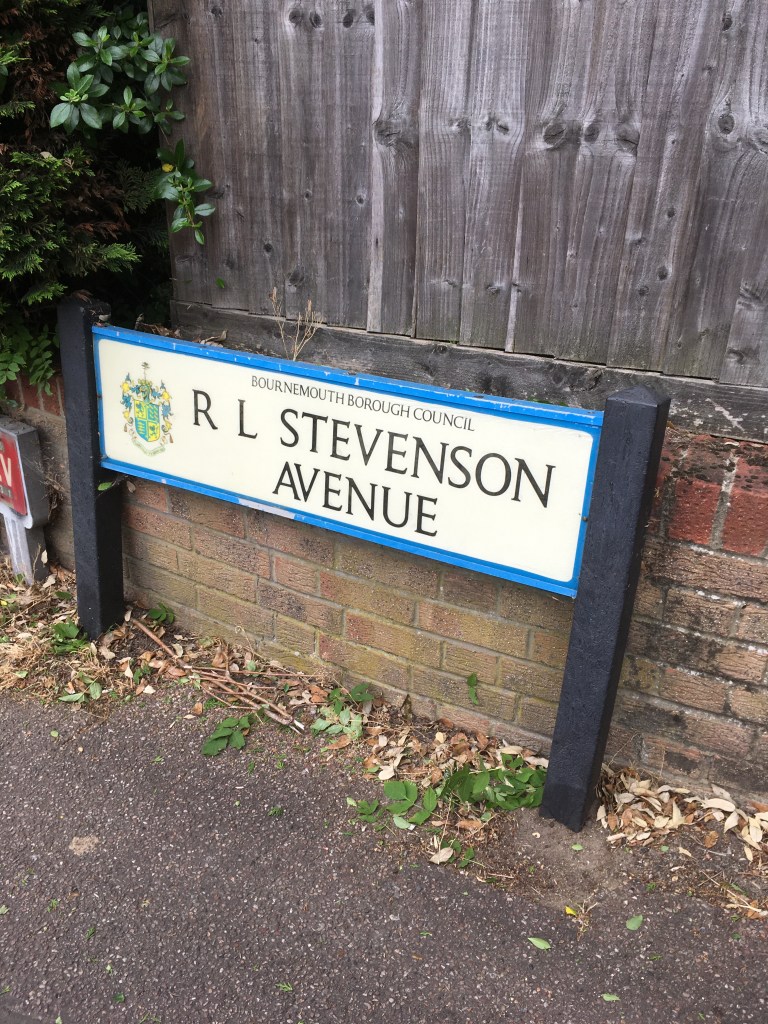
    What of Skerryvore?  Sadly, it was destroyed during the Second World War by enemy bombers on 16 November 1940.  Thankfully the remains of the house have been preserved to the extent that it is possible to see the layout of the ground floor.  Nearby in the grounds, there is a little monument inspired by the original Skerryvore lighthouse.  The memorial stone reveals the garden was designed and constructed by the former Bournemouth Corporation in 1957 in memory of the writer.  Nearby, can be found R L Stevenson Avenue.  Although Stevenson may not have enjoyed the health cure he so eagerly sought, his time at Skerryvore will be remembered.

    Leave a comment